Cognitive biases in trading: When the real enemy is in our heads
One of the interesting things about trading is that it is precisely after studying graphs, indicators, financial reports and macro that we discover that the real challenge lies somewhere else entirely: in our heads.
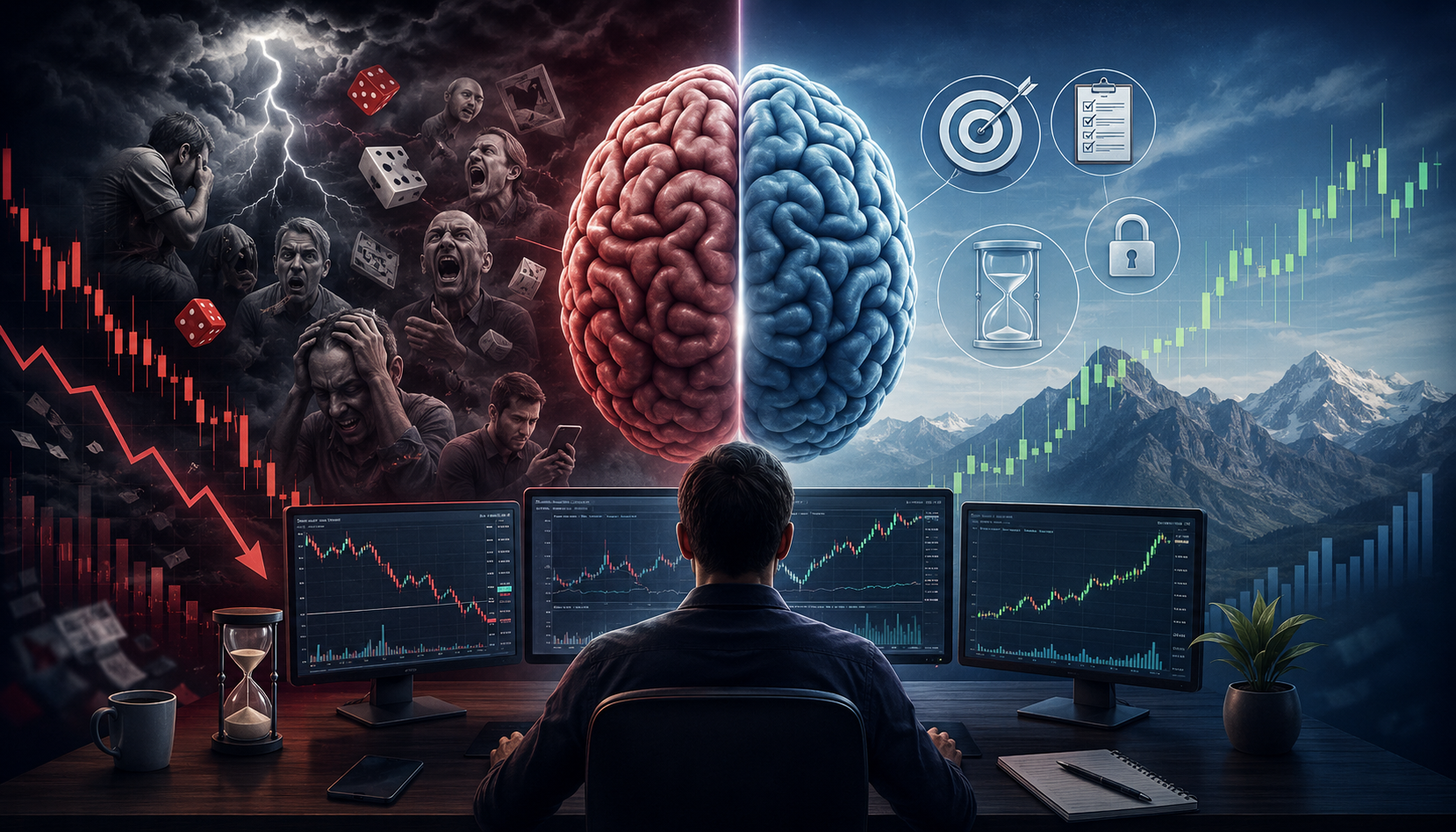
Quite a few traders know how to analyze the market quite well. They understand trends, recognize patterns, know how to talk about support, resistance, multiples and interest rates. And yet, in real time, when the money is on the table and the graph starts to move against us, something changes. Suddenly the decisions are less clean. Fear sets in. Ego intervenes. Hope begins to speak. And sometimes, without noticing, we are no longer managing a position — we are managing an emotional relationship with a stock.
This is where cognitive biases come into play.
Cognitive biases are essentially thinking errors that repeat themselves. They don't happen because we are stupid, but because our brains are built to work with shortcuts. In ordinary life, it even helps us. In commerce, however, these shortcuts can be costly.
Confirmation bias: seeing only what we are comfortable seeing
Let’s say a trader bought a certain stock because he believes it is on the way to a breakout. From the moment he gets in, he starts looking for information that supports his opinion. He reads positive articles, pays attention to optimistic analysts, gets excited about every little green candle and ignores signs of weakness.
If the stock drops, he tells himself that it is just a correction.
If the cycle weakens, he explains that it is temporary.
If a negative article comes, he is sure that the market is exaggerating.
This is the confirmation bias: we are not really looking for the truth, but for evidence that we are right.
This is a big problem in trading, because the market does not pay us for being convinced. It pays us for knowing how to react correctly when reality changes.
The way to deal with this is to ask a simple question in advance:
What needs to happen for me to realize that I was wrong?
If there is no clear answer, there is probably no real plan. There is mainly a story that we are telling ourselves.
Loss aversion: Why is it so hard to press the sell button?
One of the most familiar phenomena among traders is the difficulty of cutting a loss. Almost anyone who has been in the market long enough knows this internal dialogue:
“I’m not selling now.”
“It’s just a loss on paper.”
“It’s already gone down a lot, should I sell now?”
“I’ll wait for it to come back a little and then I’ll get out.”
The problem is that sometimes that “little bit” doesn’t come. A small loss, one that could have been closed and forgotten about, turns into a big loss. Then it’s even harder to act, because now it’s not just about money — it’s about ego, a sense of failure, the feeling that “I’m not ready to admit I was wrong.”
But in trading, a small loss is not a failure. It’s part of the job. Like a business cost. The real problem is not a small loss, but the inability to stop it in time.
Therefore, a stop should not be set when the position is already going down and your heart is beating fast. It should be set before entering. When your head is still clear.
A stop sign is not a punishment. It's a seat belt.
FOMO: The Fear of Being Left Out
There are stocks that you simply can’t ignore. They’re rising fast, everyone’s talking about them, the groups are full of messages, the chart looks like it’s not going to stop. Then comes the dangerous sentence:
“I’ll just get in a little bit, so I don’t miss out.”
That’s exactly FOMO — the fear of missing out.
The problem is that we usually feel FOMO the strongest precisely after the move has already taken place. That is, after the risk has increased and the ratio between the opportunity and the risk is no longer attractive.
Entering out of FOMO is usually not a planned trade. It’s an emotional reaction. The trader doesn’t ask where the stop is, what the target is, what the risk-reward ratio is, or what will happen if the stock corrects 10%. He simply doesn’t want to be the only one not in.
But in the capital market, there’s no one trade that you have to take. There will always be another opportunity.
The problem is not to miss a trade. The problem is to chase a bad trade just because others are already in.
Overconfidence: The Danger That Comes After Success
Surprisingly, one of the most dangerous periods for a trader is not after losses — but rather after a few nice profits.
Suddenly everything seems clear. The trader feels like he “understands the market.” He increases positions, shortens testing processes, forgoes a stop here and there, and even enters trades that he would have previously filtered out.
A streak of successes can be dangerous, because it causes us to confuse a good process with luck. Sometimes we profited because we did the right thing. Sometimes we profited because the market was simply in our favor. The difference between the two is critical.
A good trader doesn’t just check if the trade was profitable. He checks how it was profitable.
Was there a plan?
Was there risk management?
Would I take the same trade again under the same conditions?
Or did I just cast a line and a fish came out by chance?
This is a less pleasant question, but it is much more important than the final line in profit and loss.
Anchoring: “But it used to be $100”
Another very familiar bias is anchoring to past price. A stock drops from $100 to $40, and the natural reaction is to think it’s “cheap.” After all, it used to be $100.
But the market doesn’t work that way. Just because a stock traded at a certain price in the past doesn’t mean it has to go back there. Maybe the company has changed. Maybe interest rates have changed. Maybe growth has weakened. Maybe the entire sector has been repriced.
A past price is not a target. It’s just historical data.
The right question is not “Where was it?” but:
What justifies its price today, and what could justify a higher price in the future?
This is a very important distinction, especially in stocks that have fallen sharply. Sometimes they really are an opportunity. Sometimes they just seem cheap because we remember a price that is no longer relevant.
The Herd Effect: If Everyone Is There, Maybe I Should Too?
People like to go with the crowd. It’s natural. There’s a sense of security in that. If everyone is talking about the same stock, the same sector, or the same investment idea — it’s easy to feel like they might know something we don’t.
But in the capital market, the herd usually comes late. When the topic is already in the headlines, when the excitement is at its peak, when the best stories are circulating everywhere — the risk is often much higher than it seems.
This doesn’t mean that you shouldn’t join a strong trend. On the contrary, trends can last much longer than you think. But there’s a difference between joining a trend with a plan and getting carried away by the noise.
A good question to ask before entering a popular trade is:
Would I buy this even if no one was talking about it?
If the answer is no, the trade may have been born more from social influence than from independent analysis.
The Sunk Cost Bias: Staying Just Because We’ve Already Lost
This is perhaps one of the most painful biases. We hold a losing position not because we truly believe in it today, but because we’ve already lost money on it.
The phrases are familiar:
“I’m already down 20%, there’s no point in getting out.”
“I’ll wait for it to recover.”
“I’m not selling at a loss like that.”
But the market doesn’t know at what price we bought. It also doesn’t take into account how much time we invested in the analysis, how much we believed in the idea, or how much we want the deal to succeed.
The only question that matters is:
If I didn’t own the stock today — would I buy it now?
If the answer is no, we may not be holding an investment. We are holding hope.
So how do you deal with all this?
First of all, it is important to understand that you cannot eliminate emotions from trading. Anyone who says they trade without emotions probably either doesn't really trade, or is simply not aware of themselves.
The goal is not to become a robot. The goal is to build a system that prevents emotions from making decisions on their own.
A plan before every trade
Before entering a trade, you need to know a few basic things:
Why am I entering?
Where am I going wrong?
Where is the stop?
Where is the target?
What is the position size?
How much am I willing to lose if the trade doesn't work?
These are simple questions, but in real time they make a huge difference. Because when there is no plan, every movement on the screen becomes a drama. And when there is a plan, it is easier to understand what needs to be done.
Trading Journal: The Trader's Best Look
A trading journal is not just a table of profits and losses. It is a psychological tool.
It is worth writing down not only what I bought and sold, but also what I entered, how I felt, whether I followed the plan, whether I moved a stop, whether I entered under pressure, whether I exited too early, whether I increased a position for no reason.
After a few dozen trades, you begin to see patterns. For example, a certain trader loses mainly when he enters after a sharp move. Or when he trades after a loss. Or when he increases a position precisely after a series of profits.
And as soon as you see the pattern, you can start to treat it.
Position Size: The Simplest Antidote to Stress
Many psychological problems in trading start from the wrong position size. When the position is too large, every small drop feels like an event. Every red candle looks like a threat. Every announcement in the market jumps the pulse.
A position of the right size allows you to think.
Too big a position makes us react.
A simple rule: if the deal doesn't let you sleep peacefully, it's probably too big.
Check the other side too
Before every good deal, it's worth doing a little exercise: try to convince yourself why not to enter.
If we want to buy, we'll build the bearish argument.
If we want to sell, we'll look at what could actually surprise us on the upside.
This is not meant to confuse us, but to balance us. Because once we fall in love with a trading idea, we stop seeing it in a clean way.
Separate Analysis from Execution
It is highly advisable to perform most of your analysis when the market is calm, or even closed. In real time, when the price is moving quickly, it is difficult to think objectively.
A professional trader does not invent a new strategy on every candle. He comes up with a plan, and during trading mostly executes it. It sounds less exciting, but it usually works much better.
Accepting losses as part of the profession
Ultimately, you can't trade without losing. Losing is part of the game. The problem is not the loss itself, but how we react to it.
A trader doesn't have to be right on every trade. He has to manage risk, maintain discipline, and make sure that the profits on the good trades are large enough in relation to the losses on the bad trades.
Once you understand this, every small loss stops being a drama. It becomes another factor in the process.
The Bottom Line
Cognitive biases are an integral part of trading. They will appear in everyone: beginners, advanced, and experienced traders. The difference is not who feels fear, greed, or overconfidence. The difference is who recognizes it in time and does not let it manage the position.
Good trading is not only knowing how to read a chart.
It is also knowing how to read yourself.
The trader who is successful over time is not the one who has no emotions — but the one who has built a system that prevents emotions from turning into expensive decisions.
Have a take on this?
Jump into the TradeTechAI Discord to discuss this article with other traders.
Written by
Admin User
Editor
Editor at TradeTechAI, covering market analysis, trading strategies, and portfolio insights.