You can recognize technical patterns, understand reports, read trends, and build a great strategy and still lose money because of fear, greed, vindictiveness, ego, or lack of discipline. In day trading, where decisions are made quickly and money moves before your eyes in real time, psychology is not a nice addition. It is the heart of the game.
The trader who does not know how to manage his emotions will quickly discover that the market manages them for him.
Why is day trading so emotionally charged?
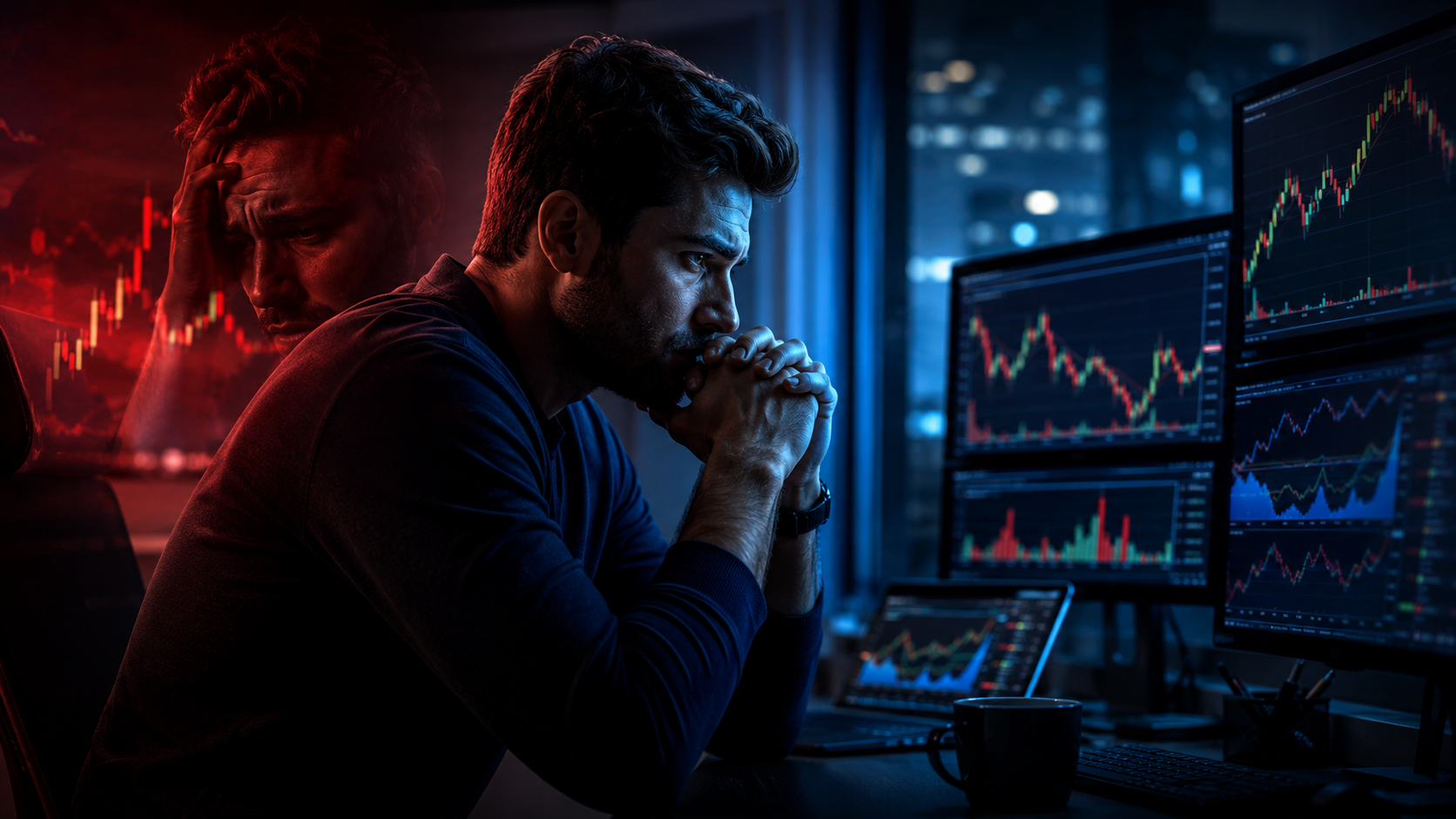
Day trading creates an almost perfect environment for emotional stress. There is real money on the table, fast moves, repeated decisions, fear of missing out, fear of losing, and sometimes a sense that every trade is a personal test.
When a trade goes in our favor, it is easy to feel smart, strong, and in control. When a trade goes against us, suddenly other thoughts arise:
Maybe I am not good at this?
Maybe I should increase to get back?
It will turn around in a moment.
I am not getting out now, it is probably just a shake-up.
The problem is that the market is not interested in our emotions. It does not know that we entered the trade, it does not care where our stop is, and it certainly does not intend to compensate us for a previous loss. The market simply moves. The emotional interpretation is ours.
The First Enemy: Fear
Fear is one of the most dominant emotions in trading. It comes in several forms.
There is fear of losing, which causes a trader to exit a good trade too quickly just to lock in a small profit. There is fear of entering, even when the pattern meets all the criteria. And there is fear of missing out, FOMO, which causes a trader to chase a stock that has already surged, just because everyone else is in.
Fear itself is not the problem. Fear is a natural mechanism designed to protect us. The problem begins when fear takes over and replaces the trading plan.
A professional trader does not try to erase fear. He learns to recognize it, give it a name, and act according to the rules even though it is there.
The Second Enemy: Greed
If fear makes us exit too early, greed makes us stay too long.
A good trade starts working, the profit increases, and then the thought appears: maybe this is just the beginning. Instead of realizing a part, moving a stop or acting according to the plan, the trader begins to fantasize. He already calculates how much he will earn if the stock continues another 5%, 10%, 20%.
Then comes the correction.
The big profit turns into a small profit, the small profit turns into zero, and sometimes the trade even closes at a loss. Not because the idea was bad, but because the trader forgot that the goal in trading is not to maximize each trade, but to manage a series of trades consistently.
Greed is not the desire to profit. The desire to profit is legitimate. Greed is the moment when the trader stops managing risk and starts betting on a dream.
The Third Enemy: Market Revenge
One of the most dangerous mistakes in day trading is revenge trading. It happens after a painful loss, especially one caused by a mistake.
The trader loses, gets upset, and immediately looks for a new trade to make back the money. The problem is that at this point he is no longer really analyzing the market. He is trying to fix his ego.
Revenge trading is usually characterized by too-fast entries, position enlargement, wide or non-existent stops, and an internal feeling of pressure. This is not a strategy. It is an emotional reaction.
In the market, the desire to make back now is one of the shortest routes to a bigger loss.
The Fourth Enemy: Ego
Ego makes a trader fall in love with his own opinion. He enters a trade with a certain assumption, but when the market proves that the assumption doesn’t work — he refuses to admit his mistake.
Instead of saying the trade didn’t work, I’m out, he says: the market is wrong.
The big players are manipulating.
It has to come back.
I don’t sell at the bottom.
Sometimes he’s right, and the price really does come back. The problem is that such a habit is very dangerous, because it teaches the trader to break the rules. One time when the price doesn’t come back is enough and the damage can be very great.
A good trader doesn’t have to be right in every trade. He has to know how to lose properly.
Discipline: The Trader’s Real Advantage
Many traders are looking for the perfect indicator, the secret strategy, or the “perfect entry.” But in day trading, the greatest advantage is often the ability to execute the same plan over and over again without being swayed by emotional noise.
Discipline in trading doesn’t mean being a robot. It means knowing in advance what to do, and then acting accordingly even when emotions try to convince us otherwise.
Discipline is expressed in simple questions:
Did I enter according to my rules?
Is the position size appropriate for the risk?
Is the stop loss pre-defined?
Is there a target or management plan for the trade?
Am I acting from analysis or from pressure?
The clearer the answers are before entering a trade, the less likely it is to make emotional decisions in real time.
Managing Emotions Begins Before Opening a Trade
A common mistake is to think that managing emotions begins when a trade is already open. In fact, most of the psychological work needs to be done before the button is pressed.
Before each trade, the trader needs to know:
What is the reason for entering?
Where is my mistake proven?
How much am I willing to lose?
What is the first profit target?
What will I do if the trade starts working?
What will I do if it moves quickly against me?
When there are no answers in advance, emotion fills the void. And when emotion makes decisions in trading, the result is usually expensive.
The Importance of Position Size
One of the most important tools for emotional management is actually a completely technical tool: position size.
Most traders don't break because of small, planned losses. They break because of positions that are too large. When the position is too large, every small movement in price feels like a threat. The pulse rises, thinking shortens, and the trader starts acting from the gut.
The right position size allows the trader to think. It allows the trade to breathe. It allows you to meet the stop without feeling like the world is collapsing.
Simply put: if the position makes you lose judgment, it's too big.
Trading Journal: The Trader’s View
A trading journal is one of the most important tools for psychological improvement. Not only to record entries and exits, but to understand the trader’s behavioral patterns.
A good journal doesn’t just include numbers. It also includes questions like:
How did I feel before entering?
Did I follow the plan?
Did I exit for a professional reason or out of fear?
Did I increase a position out of strategy or out of ego?
Was the loss part of the method or a behavioral error?
Over time, the journal reveals an important truth: Most traders don’t just have a knowledge problem. They have emotional patterns that repeat themselves.
Once you identify the pattern, you can start to correct it.
How do you build mental toughness in trading?
Mental toughness is not built in a day. It is built through process, repetition, discipline, and experience. Here are some principles that help a trader develop stability:
1. Set a maximum daily loss
Once you reach your predetermined daily loss, trading is over. Not because there are no opportunities, but because the quality of decision-making after a big loss usually decreases.
2. Set a maximum number of trades per day
Multiple trades are often a sign of restlessness and not professional trading. Setting a limit in advance helps prevent overtrading.
3. Take a break after a painful loss
Not every loss requires an immediate response. Sometimes the most professional action is to get up from the screen, take a breath, and come back only when your head is clear.
4. Work with scenarios, not with hopes
A trader should not hope that the market will do something. He should define what he does in every situation.
5. Measure the process, not just the result
A profitable trade executed against the rules is not necessarily a success. A losing trade executed exactly according to plan can be a good trade. In professional trading, the process is just as important as the result.
The Difference Between an Amateur and a Professional Trader
The amateur trader asks: How much can I make?
The professional trader first asks: How much can I lose?
The amateur trader seeks certainty.
The professional trader understands that there is no certainty, there are probabilities.
The amateur trader gets excited about a big profit.
The professional trader gets less excited, because he knows that both profit and loss are part of the game.
The amateur trader wants to be right.
The professional trader wants to be consistent.
And this is perhaps the most important point: in day trading, the winner is not the one who gets the most excited. The winner is the one who manages to remain stable when the market tries to shake him.
Summary: Self-control before market control
Day trading is a difficult profession because it requires a rare combination of speed, accuracy, flexibility and discipline. But above all, it requires self-control.
You can't control the market. You can't control the news. You can't control algorithms, institutions or sudden movements. But you can control your position size, your stop, your work plan, your number of trades, and your emotional response.
A good trader is not someone who doesn't feel fear, greed, or frustration. He's someone who feels them and still doesn't let them manage his money.
Ultimately, the psychology of day trading isn't just about knowing when to enter and when to exit. It's about knowing who you are in front of the screen, how you react under pressure, and whether you're able to act according to a method even when the market is testing you.
Because in day trading, before you beat the market, you have to learn not to lose to yourself.
Have a take on this?
Jump into the TradeTechAI Discord to discuss this article with other traders.
Written by
Michael Chen
Trading Psychology Expert
Michael Chen is a contributor at TradeTechAI, covering market analysis, trading strategies, and portfolio insights.