
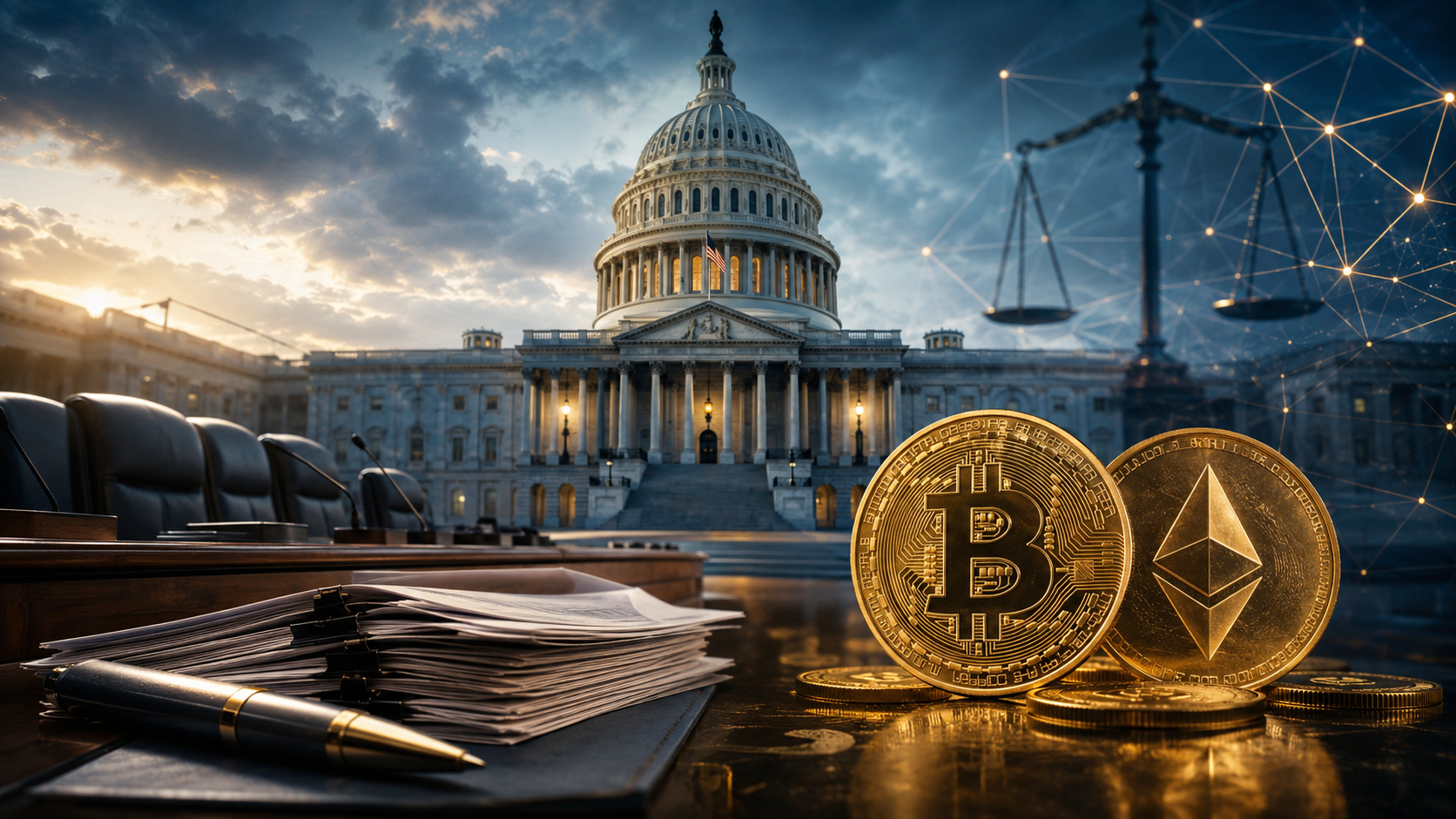
The U.S. Senate Banking Committee yesterday approved the Digital Asset Market Clarity Act, one of the most important crypto bills currently before Congress. The vote was 15-9, with the support of all Republicans on the committee and two Democrats. This is a significant step for the crypto industry, as the law is designed to resolve one of the key problems that has plagued the industry for years: the uncertainty surrounding who oversees what the SEC, the CFTC, or other regulators.
What is the law trying to do?
The main goal of the law is to create a clear framework for digital assets in the US. Today, many crypto projects live in a gray area: Is the token a security? Is it a digital commodity? Should trading in it be under the SEC or the CFTC? The law tries to establish clearer rules for classifying digital assets, and mainly to separate situations in which a token is sold as part of an investment in a company or project, and a situation in which the token itself functions as an asset on a decentralized network.
Why did the market get excited?
The initial market reaction was positive. Crypto stocks like Coinbase rose after the vote, and Bitcoin strengthened around the event, as investors saw the committee’s approval as a sign that the prospect of comprehensive legislation in the US had increased.
The crypto market is asking for clear regulation. When companies know what is allowed, what is not, who they are registering with and how they operate, it is easier to build products, raise capital, bring in financial institutions and develop operations in the US.
Key points in the bill
The bill has several key layers:
First, it attempts to better define when a digital asset is a security and when it is a digital commodity. This is especially critical after years of battles between crypto companies and the SEC.
Second, it includes disclosure requirements for certain projects, including initial and semi-annual disclosures, with the goal of giving investors better information without necessarily applying all the burdensome registration requirements of the traditional securities market.
Third, the bill also addresses the prohibition of money laundering and terrorist financing. According to the committee document, brokers, dealers, and exchanges of digital assets will be considered financial institutions and therefore will be required to have customer identification and due diligence programs.
Fourth, there is a reference to DeFi, independent wallets, and developers. The law includes sections that protect software developers and certain technical activities from automatic classification as regulated financial activities, and also states that federal agencies cannot prevent a person from holding digital assets in a self-hosted wallet, while maintaining enforcement powers in the areas of money laundering, sanctions, and terrorist financing.
The Big Fight: Stablecoins, Banks, and Interest
One of the most sensitive areas of the bill is the issue of stablecoins. Traditional banks fear that stablecoins will begin to compete with bank deposits, especially if crypto companies can offer rewards or returns to holders.
The American Bankers Association has pressured Republican senators to tighten the provisions on stablecoins, arguing that such rewards could draw deposits from the banking system. The wording of the bill, according to the committee document, prohibits the payment of interest or passive deposit-like returns on stablecoin balances, but allows for activity- or transaction-based rewards under joint rules by the SEC, CFTC, and Treasury Department.
It’s an interesting compromise: On the one hand, stablecoins are not allowed to become bank deposits in any sense. On the other hand, the ability of crypto companies to build business models around payments, usage, and incentives is not completely stifled.
The Political Minefields: It’s Not a Law Yet
Despite the committee approval, it’s important to make no mistake: The law has not yet been passed. It needs to pass the full Senate, reconcile with the versions and positions of other committees - especially the Senate Agriculture Committee, which has authority over the CFTC - and then go through the House of Representatives before it can reach the president’s signature.
The big challenge is political. The Senate usually requires a large enough majority to overcome a filibuster, meaning Republicans will need significantly more Democratic support than the two senators who supported the committee.
What’s troubling Democrats?
Democratic opposition focuses on several issues. The first is concern that the law is “too friendly” to the crypto industry and opens the door to weak regulation. The second is concern about inadequate enforcement against money laundering, terrorist financing, and sanctions evasion. The third is the issue of conflicts of interest, especially around the possibility that political figures or their families could profit from crypto ventures while promoting industry-friendly regulation.
Potential Impacts on the Crypto Market
If the law ultimately passes, the impact could be far-reaching.
For U.S. crypto exchanges, it could reduce legal risk and open the door to a more orderly listing of digital assets. Coinbase is one of the biggest potential beneficiaries, as its business model is heavily dependent on offering broad trading of digital assets under a clear regulatory framework.
For projects and tokens, the law could reduce the fear that any token will automatically be considered a security. This could encourage IPOs, network development, capital raising, and operations in the U.S.
For Bitcoin, the impact is more indirect. Bitcoin is already generally viewed as a more decentralized digital asset rather than a security. But clear legislation could strengthen the legitimacy of the entire industry, increase institutional entry, and improve the overall risk environment.
For Ethereum and altcoins, the impact could be more significant, as much of the regulatory debate is about tokens, protocols, DeFi, and assets that lie between the worlds of securities and commodities.
For stablecoins, the law could draw clearer lines between use as a means of payment and direct competition with bank deposits. This is a critical area, as stablecoins are arguably the most important bridge between crypto and the traditional payment system.
Where does it go from here?
The next step is to try to advance the bill to a vote in the Senate and combine it with the work of the Agriculture Committee, because of the question of the CFTC’s powers. At the same time, talks will continue on amendments in the areas of money laundering, sanctions, ethics, stablecoins and consumer protections.
The problem is the timetable. As the US midterm elections approach, the political window for passing complex legislation is closing. If the bill does not pass this year, and especially if there is a change in control of the House of Representatives in the midterm elections, the chances of its passage in the near future could decrease significantly.
The bottom line
Yesterday’s vote is a significant victory for the crypto industry, but it is not the end of the story. This is an important step on the path to making crypto a more regulated financial market in the US with a clearer division of powers between the SEC and the CFTC.
But there are still three big minefields:
Democratic opposition, mainly around consumer protection, money laundering and conflicts of interest.
Pressure from banks, mainly around stablecoins and competition for deposits.
A tight political schedule ahead of the midterm elections.
So, for the markets, the vote is a positive signal but not a final approval. If the law moves forward, it could be one of the most important regulatory events in the history of US crypto. If it stalls, the market will return to the familiar reality: lots of innovation, lots of money, and a lot of regulatory uncertainty.
Have a take on this?
Jump into the TradeTechAI Discord to discuss this article with other traders.
Written by
Admin User
Editor
Editor at TradeTechAI, covering market analysis, trading strategies, and portfolio insights.