
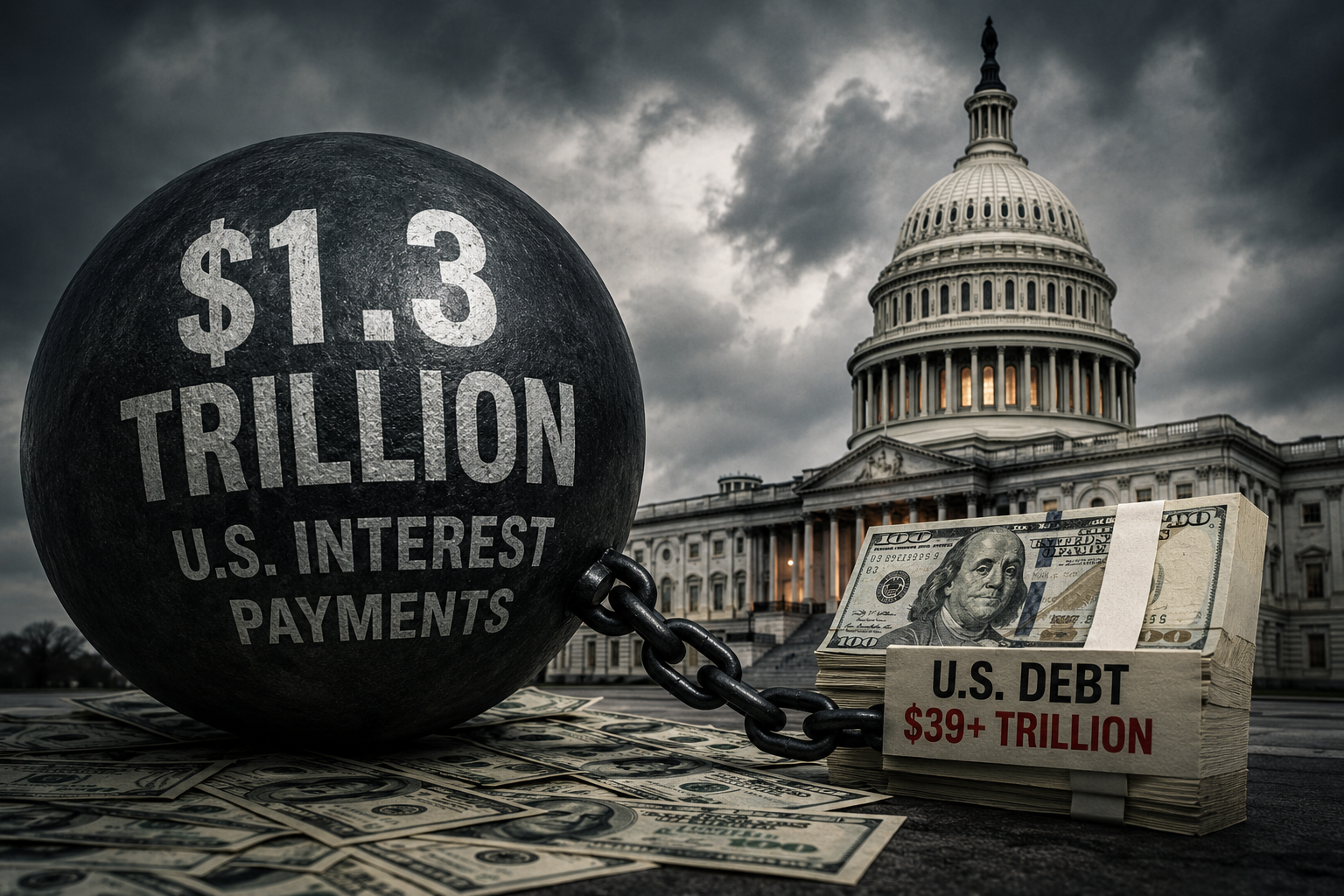
U.S. government interest expense on public debt has reached a record level of roughly $1.3 trillion over the last 12 months. This is a dramatic number not only because of its absolute size, but because of how quickly it has risen. Just a few years ago, interest costs were much lower. Today, they are moving closer to the largest spending categories in the federal budget.
As of June 2026, total U.S. public debt is approaching $39.3 trillion. This includes debt held by the public, such as individuals, institutions, funds, banks, foreign governments and the Federal Reserve, as well as intragovernmental debt held within different parts of the U.S. government. The U.S. Treasury reports total public debt outstanding daily, including the split between publicly held debt and intragovernmental holdings.
The core problem is not only the size of the debt. It is the cost of financing it. For many years, the United States benefited from extremely low interest rates. The government could issue new debt and refinance old debt at relatively low cost. But after the sharp rise in rates over the past few years, maturing low-cost debt is gradually being replaced by new debt issued at much higher yields. That is why the interest bill can keep rising even when the Federal Reserve is no longer actively raising rates.
This creates a dangerous fiscal mechanism. More debt requires more Treasury issuance. More issuance requires the market to absorb more supply. If investors demand higher yields to hold that debt, interest costs rise. Higher interest costs widen the deficit. A wider deficit requires even more borrowing. This creates a feedback loop in which debt feeds interest costs, and interest costs feed the debt.
In May 2026, gross interest payments on Treasury debt jumped by about $40 billion from a year earlier and reached a monthly record of roughly $133 billion. In April, gross interest had already reached a previous monthly record of about $112 billion. This is not a one-month anomaly. It is part of a broader trend of rapidly rising debt-servicing costs.
It is important to distinguish between gross interest and net interest. Gross interest reflects total interest payments on public debt. Net interest, which is more commonly used in federal budget analysis, includes certain offsets and adjustments. According to the Congressional Budget Office, the federal deficit is projected to reach about $1.9 trillion in fiscal year 2026, with rising net interest costs playing a major role in pushing deficits higher over time.
The broader message is clear: U.S. debt is not falling. It continues to rise. Total federal debt stood at about $38.5 trillion at the end of 2025, according to FRED data, and has continued to climb since then. If we are analyzing the growth of U.S. debt, the trend is unmistakable: the debt burden is expanding, and the problem becomes more serious when that rising debt meets a higher-rate environment.
In the short term, the United States still enjoys advantages that most countries do not have. The dollar remains the world’s dominant reserve currency. The U.S. Treasury market remains the deepest and most liquid bond market in the world. Foreign demand for U.S. Treasuries also remains significant. In April 2026, foreign holdings of U.S. Treasury securities stood at about $9.35 trillion.
But those advantages do not eliminate the risk. As interest consumes a larger share of the federal budget, the government has less flexibility. More money goes toward paying for past borrowing, and less remains available for future investment in infrastructure, defense, education, healthcare, research, development and social programs. In simple terms, the debt begins to compete with the real economy for resources.
For investors, this is one of the most important macro themes of the next decade. Treasury yields are no longer driven only by inflation and Federal Reserve policy. They are also driven by deficits, Treasury supply, foreign demand, the dollar and confidence in America’s ability to stabilize its fiscal path.
The main risk is not necessarily an immediate debt crisis. The United States is still protected by its economic scale, financial depth and monetary power. The bigger risk is that a growing share of the budget will be absorbed by interest payments, reducing fiscal flexibility and making the U.S. economy more sensitive to any further rise in yields.
The conclusion is clear: U.S. debt is no longer just a large number in government reports. It is becoming an active force shaping interest rates, the federal budget, the bond market, the dollar, equity valuations and the government’s ability to support future growth. As long as the economy remains strong and demand for Treasuries remains deep, the system can continue to function. But as the interest bill moves closer to the largest items in the federal budget, the question becomes less technical and more strategic: how long can the world’s largest economy keep refinancing expensive debt without paying a higher price?
Have a take on this?
Jump into the TradeTechAI Discord to discuss this article with other traders.
Written by
Admin User
Editor
Editor at TradeTechAI, covering market analysis, trading strategies, and portfolio insights.