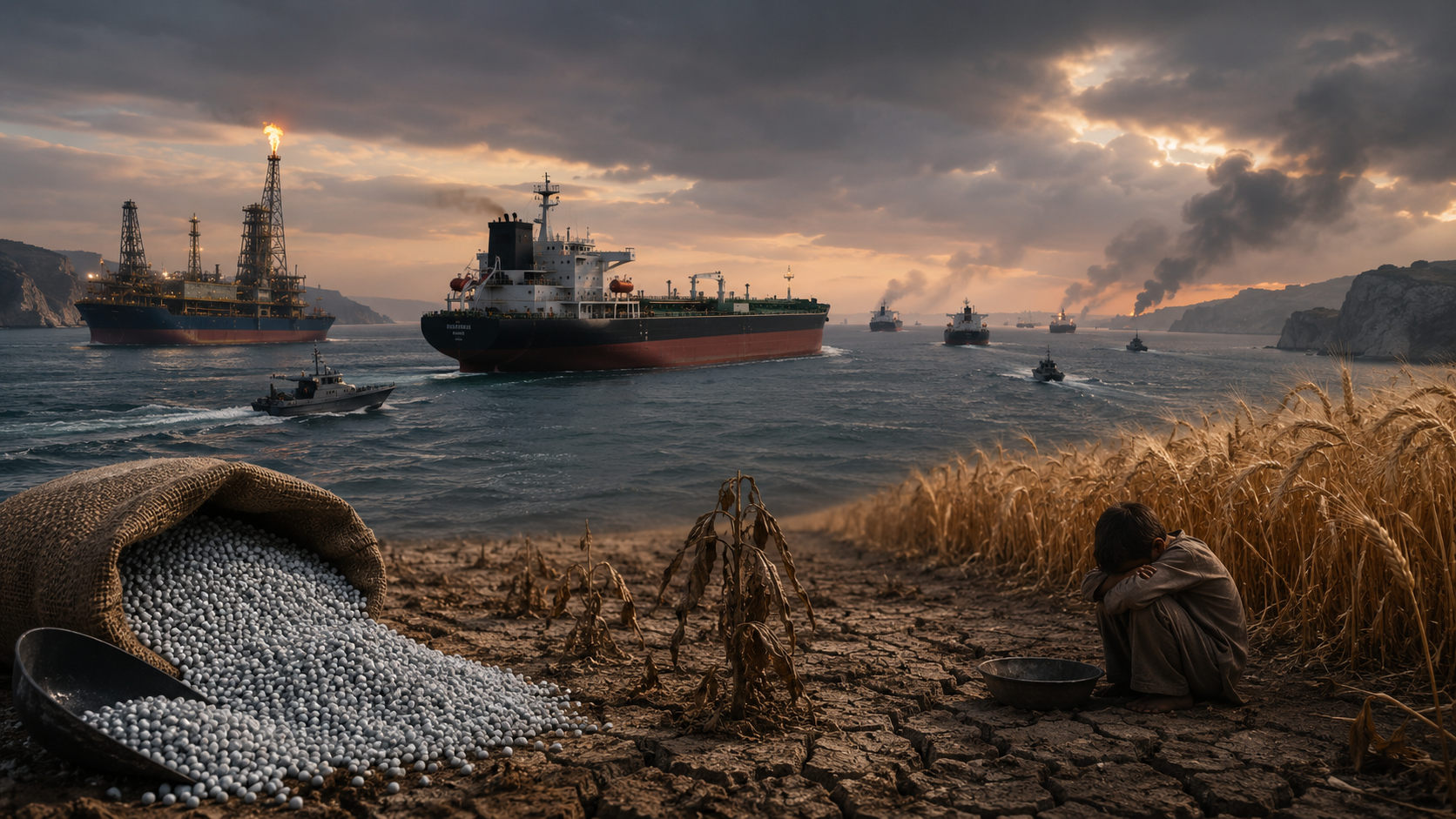
The world usually thinks about the Strait of Hormuz through the lens of oil. When tensions with Iran rise, markets immediately focus on Brent, WTI, gasoline prices, inflation and energy stocks. But the bigger and more dangerous story may be further down the chain: natural gas, ammonia, sulfur, fertilizers, crop yields, food prices and global hunger.
The Hormuz crisis is not only an energy shock. It could become an agricultural shock. And when an agricultural shock meets a world where hundreds of millions of people are already facing food insecurity, the result can be far more serious than a higher oil price.
Why does Hormuz matter for fertilizers?
The Strait of Hormuz is one of the world’s most important chokepoints. It is usually discussed because of oil and gas, but the region is also critical for fertilizers and fertilizer inputs. According to Carnegie, roughly one-third of global seaborne fertilizer trade normally passes through the Strait of Hormuz, while the Gulf region is a major hub not only for energy, but also for fertilizer-related supply chains.
The most important fertilizers for agriculture are nitrogen, phosphate and potash. Nitrogen fertilizers are highly dependent on natural gas, which is both an energy source and a feedstock for ammonia production. Phosphate and potash depend on mining, processing, logistics and global trade. When energy prices rise, shipping becomes more expensive, marine insurance rises, ports face delays and inputs do not arrive on time, fertilizer prices climb.
When fertilizer prices rise, farmers face a difficult choice: pay more, use less, or reduce planting. That is where an energy crisis becomes a food crisis.
The real problem: fertilizer affects the next harvest
Oil prices are visible every day on the screen. Fertilizer shortages work more slowly. They do not always show up immediately in the price of bread or rice. The impact comes through planting decisions, lower fertilizer use, weaker yields and then higher food prices months later.
FAO has warned that disruptions in Hormuz have already affected the movement of oil, LNG, sulfur and fertilizers, pushing up agricultural input costs and putting upward pressure on seeds and food prices. According to FAO, decisions made now by farmers and governments could determine whether the world faces a severe food price crisis within six to twelve months.
In simple terms: oil rises today, fertilizers become more expensive tomorrow, and crop yields may suffer six months from now. It is a slow chain, but a dangerous one.
Why poor countries are especially vulnerable
In wealthy countries, higher food prices are an economic and political problem. In poor countries, they can become a matter of survival. In many parts of Africa, South Asia and the Middle East, families spend a large share of income on basic food. When prices rise, there is little room to cut elsewhere.
IFPRI noted that shipping restrictions in the Strait of Hormuz have already driven sharp increases in fertilizer and energy prices. If the disruption persists, reduced fertilizer use could lower crop yields and create serious food security risks. The most vulnerable countries are those heavily dependent on fertilizer and natural gas from the Gulf, especially in Africa and South Asia.
This is the key point: global hunger is not created only when there is not enough food in the world. Sometimes there is food, but it is too expensive, in the wrong place, or beyond the reach of countries that need it most. A fertilizer crisis is therefore a double shock: it can reduce future food supply and raise current food prices at the same time.
The World Food Programme is already under pressure
The danger is even greater because the global aid system is entering this crisis with less money. According to WFP, around 318 million people are expected to face crisis levels of hunger or worse in 2026, more than double the number recorded in 2019. At the same time, declining humanitarian funding is forcing WFP to prioritize assistance for only about one-third of those in need.
ReliefWeb reported that WFP’s funding outlook for 2025 fell by 34%, from $9.8 billion in 2024 to about $6.4 billion in 2025. That means less food, fewer emergency programs and less capacity to absorb another food price shock.
One number should worry investors and policymakers alike: WFP estimated that escalation in the Middle East could push almost 45 million additional people into acute food insecurity or worse.
In other words, the world is not entering this crisis from a position of strength. It is entering it with weaker aid funding, more wars, more climate stress, more debt in developing countries and more fragile supply chains.
Why investors should pay attention
Investors often look at this type of crisis only through energy stocks. That is natural, but incomplete. A Hormuz disruption can create a chain of risks and opportunities across several sectors.
The first sector is energy. Oil and gas are the immediate reaction. If Hormuz risk persists, oil producers, LNG companies, drilling services, shipping and storage may remain in focus.
The second is fertilizers. Companies such as Nutrien, Mosaic, CF Industries, Yara and ICL may benefit from higher fertilizer prices, but investors need to be careful. Higher fertilizer prices are not always positive if energy costs rise as well, logistics are disrupted, or farmers reduce purchases.
The third is agricultural commodities. Wheat, corn, soybeans, rice and sugar could be affected if high fertilizer prices reduce yields. Investors can follow broad agricultural commodity funds such as DBA, or more focused funds like CORN, WEAT and SOYB.
The fourth is agribusiness. Agricultural equipment, seeds, irrigation, farm technology and agricultural data may benefit if governments and farmers try to produce more food with fewer inputs.
The fifth is food security as national policy. Countries may begin investing more in food storage, domestic production, local fertilizer capacity, fertilizer substitutes, desalination, irrigation and smart agriculture. This could become a multi-year megatrend.
Stocks and ETFs to watch
On the fertilizer side, the main names are:
NTR, Nutrien
One of the world’s largest fertilizer companies, with exposure to potash, nitrogen, phosphate and agricultural retail.
MOS, Mosaic
A major phosphate and potash company, sensitive to fertilizer prices, agricultural demand and energy costs.
CF, CF Industries
One of the leading nitrogen fertilizer producers, highly sensitive to natural gas, ammonia and urea markets.
ICL, ICL Group
An Israeli company with exposure to potash, phosphate, specialty chemicals and agricultural solutions. Especially relevant for Israeli investors looking for a local-global agriculture input story.
Yara International
A major Norwegian nitrogen fertilizer company, highly exposed to natural gas, Europe and global fertilizer markets.
Relevant ETFs include:
DBA
A broad agricultural commodities fund using futures contracts.
CORN, WEAT, SOYB
Focused exposure to corn, wheat and soybeans.
MOO
A broad agribusiness ETF with exposure to fertilizer companies, agricultural equipment, seeds and food-related companies.
VEGI
A global ETF focused on agricultural producers and equipment companies.
The key anecdote: fertilizer may matter more than oil
During a Hormuz crisis, everyone watches oil. But quietly, fertilizer may become the bigger story. Why? Because expensive oil hurts consumers today. Expensive fertilizer hurts tomorrow’s harvest. If tomorrow’s harvest is weaker, food prices rise, poor countries suffer, humanitarian aid becomes insufficient and the crisis turns from an oil shock into a social, political and security shock.
History shows that high food prices can trigger protests, political instability, migration, pressure on governments and higher credit risks in developing countries. That is why a fertilizer crisis is not only an agricultural story. It is a macro story.
Bottom line for investors
The blockade or disruption in Hormuz is not just another geopolitical event. It sits at the intersection of energy, fertilizers, food, inflation and global security. The longer the disruption lasts, the greater the risk that the world sees not only higher oil prices, but also higher food prices, lower crop yields and deeper hunger in vulnerable countries.
For investors, this requires a broad view. Not only oil. Not only fertilizers. The full chain matters: energy, natural gas, ammonia, urea, phosphate, potash, shipping, agriculture, food and humanitarian aid.
Investors looking for long-term opportunities should follow fertilizer companies, agricultural commodities, agribusiness firms and technologies that help produce more food with fewer inputs. But this is a volatile, political and cyclical area, highly sensitive to energy prices, weather and government policy.
Have a take on this?
Jump into the TradeTechAI Discord to discuss this article with other traders.
Written by
Admin User
Editor
Editor at TradeTechAI, covering market analysis, trading strategies, and portfolio insights.