

Quantum computing has moved in recent years from a niche academic research field into one of the most exciting stories in the capital markets. After cloud computing, artificial intelligence and semiconductors, investors are constantly looking for the next major technological wave. Quantum computing offers exactly that kind of story: revolutionary technology, a huge potential market, government involvement, major players such as IBM, Google, Microsoft, Amazon and NVIDIA, and alongside them small, highly volatile stocks that can jump dozens of percent in a single trading day.
But as with every early-stage technology, investors must separate the vision from the actual business. At this stage, most quantum companies still do not have broad commercial products, many are still losing money, and a large part of their market value is based on future expectations rather than current cash flow.
What Is Quantum Computing?
A regular computer works with bits: 0 or 1. A quantum computer works with qubits, which can represent more complex states through phenomena such as superposition and quantum entanglement. In simple terms, the goal is not to build a computer that replaces our personal computers or standard cloud servers, but rather a machine that can solve specific types of problems that classical computers struggle with.
The key applications that interest investors include drug development, chemical simulations, logistics optimization, financial modeling, cybersecurity, encryption, advanced materials and artificial intelligence. This is why quantum computing is seen not just as another technology sector, but potentially as a new computing layer for the coming decades.
Why Is the Sector Heating Up Now?
There are three main forces pushing quantum computing back into the spotlight.
The first is technological progress. IBM, Google, Microsoft, Amazon, NVIDIA and other companies are investing heavily in quantum hardware, software, simulation, algorithms and cloud-based quantum infrastructure. IBM, for example, has published a clear roadmap for advancing fault-tolerant quantum computing, including work on more advanced chips and architectures.
The second is government involvement. Countries understand that quantum computing is not only a technology field, but also a strategic one. It is connected to national security, encryption, intelligence, defense industries and the technological competition between the United States, China and Europe.
The third is the connection to AI. As artificial intelligence requires more computing power, more data and more optimization, investors are beginning to ask whether quantum computing could eventually work alongside GPUs, classical processors and cloud infrastructure. NVIDIA, for example, is not building a standalone quantum computer like IBM or Google, but it is developing CUDA-Q, a platform for hybrid quantum-classical computing.
The Main Types of Companies in the Sector
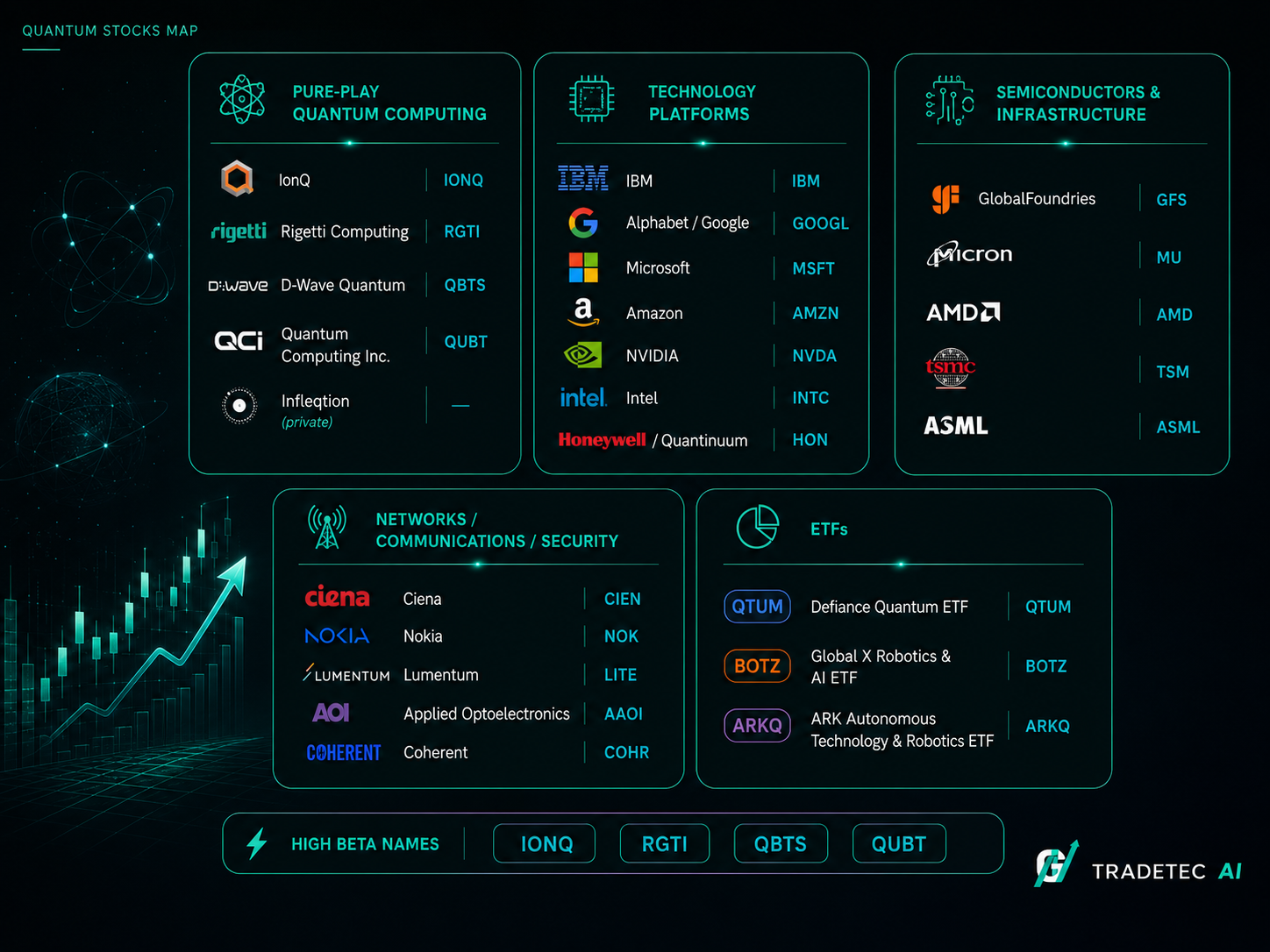
To understand quantum stocks, it is useful to divide the sector into several groups.
Pure-play quantum companies are the companies most directly associated with the theme. These include IonQ, Rigetti, D-Wave, Quantum Computing Inc. and Infleqtion. These stocks offer direct exposure to the quantum dream, but they also carry the highest risk. In most cases, these are companies with relatively small revenues, ongoing losses, future financing needs and valuations that are heavily influenced by market sentiment.
Technology giants such as IBM, Google, Microsoft, Amazon and NVIDIA provide more indirect and more stable exposure. For these companies, quantum computing is only one part of a much larger and more profitable business. Investors are not buying a pure quantum dream, but rather a strong company with a potential future option in the field.
Semiconductor and infrastructure companies such as TSMC, ASML, AMD, Micron and GlobalFoundries sit in the second circle. They may not necessarily be the direct winners of quantum computing, but if the industry grows, it will require advanced components, manufacturing, memory, equipment, computing architectures and infrastructure.
Quantum communication and security companies operate in areas such as encryption, secure communications, optical networks and advanced communications infrastructure. Names such as Ciena, Nokia and Lumentum may have indirect exposure to this part of the quantum ecosystem.
Key Stocks for Investors to Watch
IonQ – IONQ
IonQ is one of the most recognized public companies in the quantum computing space. The company focuses on trapped-ion quantum computing, an approach considered promising because of the relatively high accuracy of its qubits. IonQ’s advantage is that it has become one of the most visible public names in the sector, with partnerships, cloud access and strong interest from both institutional and retail investors.
The risk is that the stock is often priced according to a future dream rather than current profitability. That means any disappointment in revenues, guidance, technological progress or capital raising can create sharp volatility. IonQ may become one of the leaders in the field, but investors should remember that it is still a young company trying to prove a broad commercial business model.
Rigetti – RGTI
Rigetti develops quantum computers based on superconducting circuits. This is the same general technological direction pursued by companies such as IBM and Google. The advantage is that Rigetti operates at the heart of one of the most important approaches in quantum computing.
The disadvantage is intense competition against technology giants with much larger budgets. Rigetti is a highly speculative stock. It can react sharply to announcements about contracts, government grants or technological progress, but it can also fall sharply when the market shifts into risk-off mode.
D-Wave – QBTS
D-Wave is different from some of the other players because it focuses, among other things, on quantum annealing, an approach mainly designed for optimization problems. This can be relevant for logistics, planning, industry, finance and complex modeling.
D-Wave’s advantage is that it is trying to be closer to commercial use cases rather than focusing only on long-term research. The risk is that the market is still debating how much real business value this approach can generate over time compared with advanced classical computing or other quantum approaches.
Quantum Computing Inc. – QUBT
QUBT is one of the most volatile names in the sector. It attracts attention because of its direct name, its thematic exposure and its ability to move sharply around headlines. But this is exactly where investors should be especially careful. The smaller the company and the less established the revenue base, the higher the risk that the stock behaves more like a speculative trading vehicle than a stable business investment.
In stocks like these, the story in the market can sometimes move much faster than the actual business.
IBM – A More Conservative Exposure
IBM is probably one of the more conservative ways to gain exposure to quantum computing. The company is a major player in the field, but unlike the smaller quantum stocks, IBM also has businesses in cloud, software, consulting, AI and enterprise infrastructure. This means that investors are not dependent only on the success of quantum computing.
The downside is that the quantum upside is less pure. Even if the field succeeds, the impact on IBM will likely be more gradual because it is a large and diversified company. But for investors looking for a more reasonable and less volatile exposure, that may be an advantage.
Why Are Quantum Stocks So Volatile?
Quantum stocks sit exactly at the point where Wall Street tends to exaggerate: revolutionary technology, limited revenues, a big dream, little certainty and many headlines. That is why they often behave like early-stage biotech or space stocks.
When there is news about a government contract, a partnership with a major technology company, progress in chip development, federal funding or a scientific breakthrough, these stocks can jump quickly. When the market shifts toward fear, higher yields, lower risk appetite or disappointing earnings, they can fall just as quickly.
This is a sector where investors must remember one important rule: a stock can be very expensive even if the story is real.
The Big Opportunity
The opportunity in quantum computing is that if the technology matures, it could become one of the most important infrastructure layers of the next few decades. This is not just another app or software product. It is potentially a new computing layer that could affect science, medicine, finance, energy, defense, industry and AI.
If quantum computers eventually solve problems that regular computers cannot solve in a reasonable amount of time, the economic value could be enormous. Companies that control the technology, intellectual property, cloud access, hardware, software or surrounding infrastructure could become strategically important players.
The Big Risk
The risk is that the road is still long. There is a major gap between a quantum computer that demonstrates scientific capability and a quantum computer that produces consistent business value for paying customers. The sector still faces challenges related to calculation errors, qubit stability, cooling, scaling, cost, software, standards and commercial adoption.
In addition, there is competition between different technological approaches: trapped ions, superconducting circuits, neutral atoms, photonics, annealing and others. For investors, it is very difficult to know which approach will win. Some of today’s public companies may become leaders, but others may disappear, merge or remain interesting technologies without strong business models.
How I Would Look at the Sector as an Investor
I would not treat quantum stocks as the core of an investment portfolio. This is not the S&P 500, not stable value stocks and not a group of profitable companies with long histories. This is an early-stage, volatile and speculative growth sector.
The right approach, in my view, is to divide the exposure into three layers.
The first layer is indirect exposure through technology giants such as IBM, Google, Microsoft, Amazon and NVIDIA. This gives investors an option on the sector without betting only on quantum computing.
The second layer is a small basket of pure-play quantum companies such as IONQ, RGTI and QBTS. Instead of choosing only one stock as if we already know who the winner will be, it makes more sense to spread exposure across several approaches.
The third layer is made up of more speculative names such as QUBT and other smaller companies. Here, the exposure should be very limited, with a clear understanding that the risk level is high.
Bottom Line
Quantum stocks are not just another market trend. There is real technology here, government interest, major investments from technology giants and the potential for a very large market over the next decade. But from a capital markets perspective, the sector is still at a stage where the dream is much bigger than the numbers.
A smart investor should not ignore the field, but should also not chase it blindly. It is important to follow the sector, study the companies, understand the differences between the technologies, check who is actually generating revenue, who is burning cash, who has meaningful partnerships and who may have a technological advantage that can eventually become a real business.
Quantum computing could become one of the biggest stories of the next decade. But on the way there, there will be a lot of noise, a lot of volatility, many dreams and quite a few disappointments. For investors, the key question is not only which stock to buy, but how to manage risk around a field that may change the world, yet still has not proven that it can generate large-scale profits.
Have a take on this?
Jump into the TradeTechAI Discord to discuss this article with other traders.
Written by
Admin User
Editor
Editor at TradeTechAI, covering market analysis, trading strategies, and portfolio insights.