
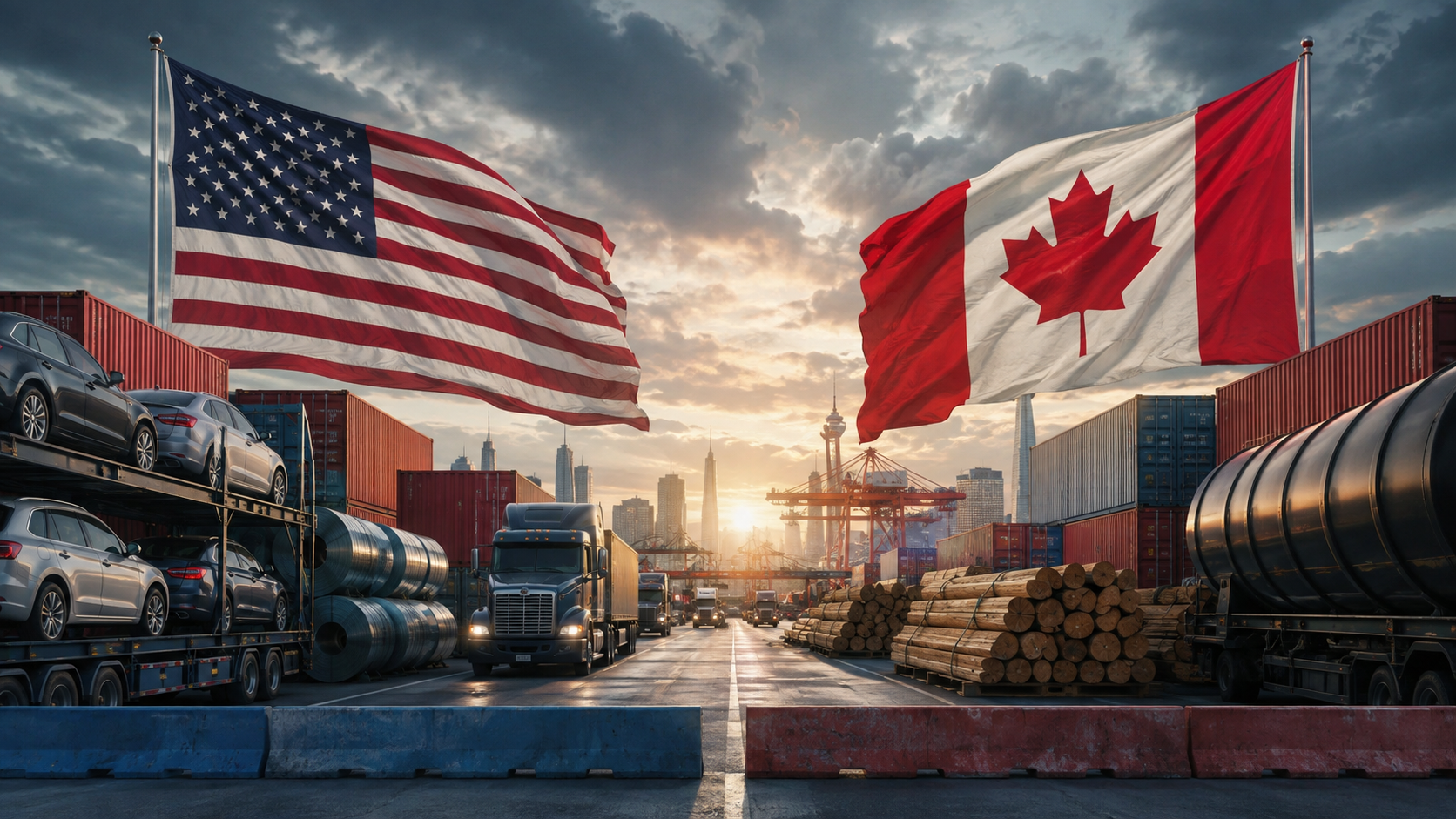
The trade war between the United States and Canada is entering a new and potentially dangerous stage. Following the collapse of negotiations, the United States imposed 50% tariffs on roughly $20 billion of Canadian goods, while Canada announced retaliatory tariffs of a similar value that are scheduled to take effect on September 8. At the same time, President Donald Trump has threatened to raise tariffs on Canadian cars, trucks and auto parts to 50% beginning in January 2027.
At first glance, it is easy to understand the argument that Canada has been one of the biggest beneficiaries of free trade with the United States. The Canadian economy gained almost unrestricted access to the world's largest consumer market, while Canadian companies benefited from supply chains deeply integrated with U.S. industry.
The numbers show just how deep that relationship has become. In 2025, total U.S.-Canada trade in goods and services reached roughly $872 billion. About 71.7% of Canadian merchandise exports went to the United States, down from 75.9% a year earlier. Canada continued to run a significant merchandise trade surplus with the U.S., while the United States maintained a surplus in services.
But an important distinction needs to be made. Canada's trade surplus does not necessarily prove that Canada has "taken advantage" of the United States or that it has been the only winner in the relationship. A very large part of that surplus comes from energy, particularly crude oil. In 2025, U.S. energy imports from Canada were worth approximately $111 billion, compared with only $26 billion of U.S. energy exports to Canada. The United States imported an average of roughly 3.9 million barrels of Canadian crude oil per day.
In other words, much of what appears to be an American trade deficit represents purchases of raw materials that the U.S. economy itself needs. Refineries, metal producers, automakers and many other American industries have been built over decades around an integrated North American supply chain.
That is why a trade war between these two countries is very different from a trade dispute between the United States and a distant economy. A vehicle can cross the border several times during its manufacturing process, with components produced in the U.S., assembled in Canada and then shipped back into the American market. A tariff imposed at each stage does not hurt only Canada — it also increases costs for American producers.
Nevertheless, if the dispute continues to escalate, Canada is clearly the more vulnerable side. The reason is simple: the U.S. economy is far larger, while exports to the United States represent a huge part of Canadian economic activity. Roughly 70% of Canadian exports still go to the American market, making it extremely difficult to replace that demand quickly. Estimates cited in Canada suggest the latest tariffs could eventually put as many as 90,000 jobs at risk.
The industries most exposed include autos, steel and aluminum, lumber, agriculture and other manufacturing sectors. The auto industry is particularly vulnerable because it effectively operates as one integrated North American industry. Canada produced roughly 1.2 million vehicles in 2025, with Toyota and Honda alone accounting for more than 75% of production. A 50% tariff on Canadian vehicles and parts could fundamentally alter the economics of producing cars in Canada.
For the United States, the picture is different. The overall macroeconomic damage is likely to be smaller relative to the size of its economy, but it is certainly not zero. Tariffs on steel, aluminum, lumber, oil, automobiles and other products can increase production costs and eventually raise prices for American consumers.
That creates one of the major dilemmas for the Federal Reserve. A trade war can weaken economic activity on one side while raising prices through tariffs on the other. In other words, it can produce an uncomfortable combination of weaker growth and greater inflationary pressure.
Canada could face the opposite monetary-policy challenge. Weaker exports, employment and investment could slow economic growth and increase pressure on the Bank of Canada to support the economy. Financial markets are already assessing what the dispute could mean for Canadian interest-rate expectations and the Canadian dollar.
Perhaps the most important consequence, however, may emerge only over the longer term. For decades, Canada was heavily dependent on the U.S. market because it was economically logical: the world's largest consumer economy was located directly across the border.
Canada is now receiving a powerful incentive to do exactly the opposite — deepen trade relations with Europe and Asia and reduce its dependence on the United States. The expansion of the Trans Mountain pipeline is already allowing more Canadian crude to reach the Pacific Coast and from there access Asian markets.
That is the paradox of American tariff policy. In the short term, the United States clearly holds the stronger hand and can exert considerable pressure on Canada. But if that pressure persists for years, it could push Canada to build alternatives and gradually reduce its dependence on the American market.
For investors, the conclusion is that there is no real winner in this conflict. Canada is likely to pay the larger economic price in the short term, but the United States also risks higher prices, disrupted supply chains and damage to one of its most important and efficient economic relationships.
Have a take on this?
Jump into the TradeTechAI Discord to discuss this article with other traders.
Written by
Admin User
Editor
Editor at TradeTechAI, covering market analysis, trading strategies, and portfolio insights.