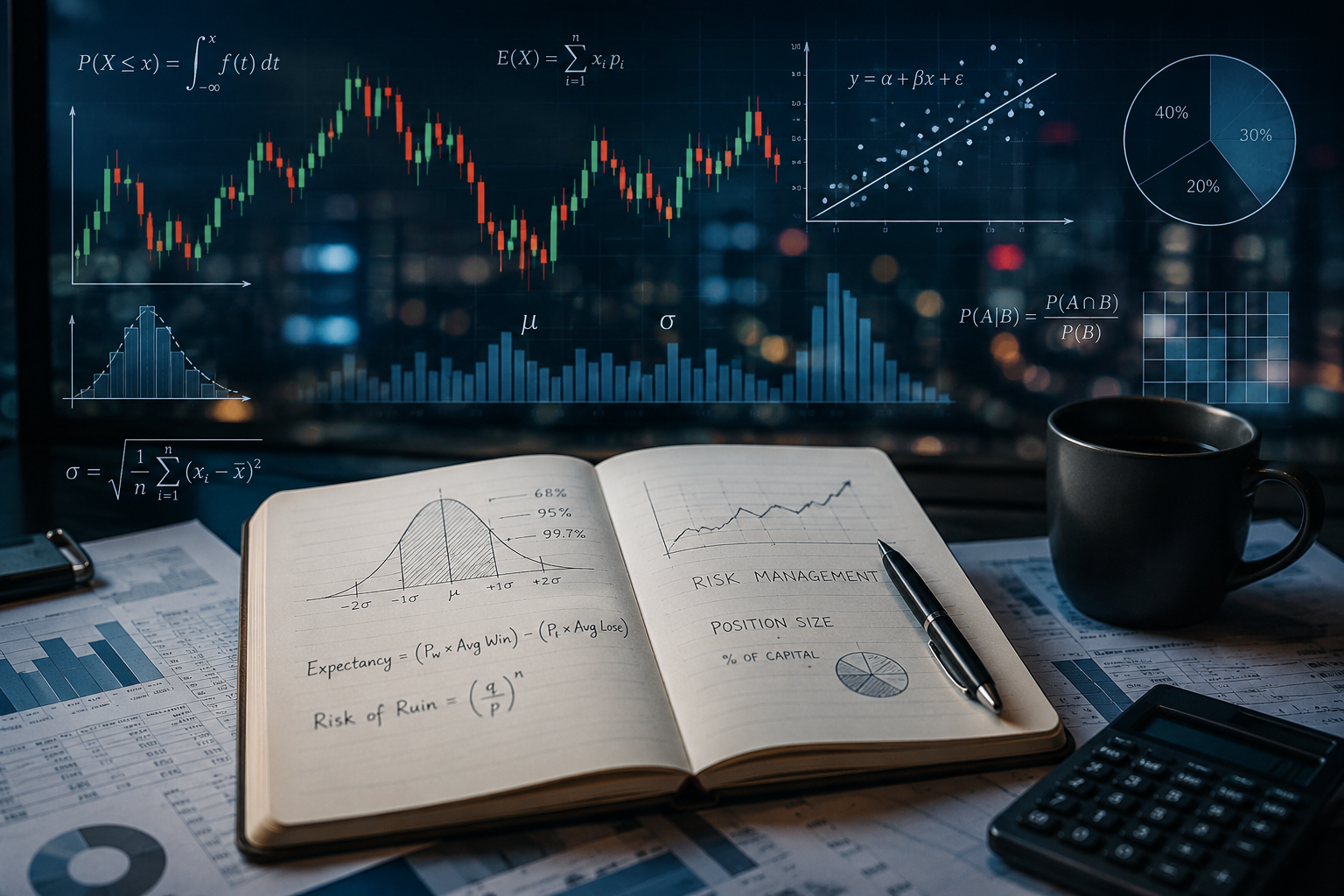

Risk Management in Trading: The Difference Between a Trader Who Survives and One Who Gets Wiped Out
Most traders begin with the wrong question: “Which stock will go up?” or “Where is the best entry point?”
But the real question is completely different: How much am I willing to lose if I’m wrong?
Because in trading, losses are part of the game. . Even the best professional traders are wrong. The difference between them and amateur traders is not the ability to predict the market perfectly, but the ability to lose in a controlled way, stay in the game, and let the good trades do the work over time.
The Market Owes Us Nothing
One of the most dangerous mistakes in trading is entering a trade with a sense of certainty.
“The chart looks great.”
“The news is good.”
“The stock has already fallen enough.”
“There’s no way it breaks support.”
But in the market, there is no such thing as “no way.” There are probabilities.
Every trade is a scenario. Not a promise. Even a high-quality technical setup can fail. A clean breakout can turn into a trap. A strong earnings report can still send a stock lower if expectations were too high. That is why risk management is not an addition to trading. It is the foundation everything rests on.
Risk Begins Before Entering the Trade
Proper risk management starts before pressing the buy button.
A trader must know three things in advance:
Where the entry point is.
Where the exit point is if the trade fails.
What the profit potential is relative to the risk.
If there is no clear answer to these three questions, it is not really a planned trade. It is a gut feeling dressed up as trading.
The stop-loss is not a “recommendation.” It is the boundary of the mistake. It is the point where the trader says: “My trade idea is no longer valid.”
Once the price reaches that level, the discussion is over. You do not move the stop out of hope. You do not “give it a little more room” without a professional reason. You do not turn a trading position into a long-term investment just because it went down.
Position Size Matters More Than the Signal
Many traders focus on signals, indicators, chart patterns and hot stocks. But in practice, one of the most important components of trading is position size.
You can enter a good trade and lose a lot because the position was too large.
You can enter an average trade and suffer only minor damage if the risk was calculated properly.
A basic rule used by many professional traders is to risk only a small percentage of capital on each trade. For example: 0.5%, 1% or 2% of the portfolio. If the trading account is $100,000 and the trader decides to risk 1% on a trade, the planned maximum loss is $1,000.
From there, the position size is calculated.
If the distance between the entry price and the stop-loss is $5 per share, and the maximum risk is $1,000, the position size will be 200 shares.
You do not buy “approximately.” You do not buy based on feeling. You calculate.
Risk-Reward Ratio: Not Every Trade Deserves an Entry
Risk management is not only about limiting losses. It is also about choosing trades where the potential reward justifies the risk.
If a trader risks $1,000 in order to make $700, he needs a very high win rate to be profitable over time. But if he risks $1,000 in order to try to make $2,000 or $3,000, even a moderate win rate may be enough.
That is why many traders look for a risk-reward ratio of at least 1:2 or 1:3. In other words, for every dollar at risk, the desired profit potential is two or three dollars.
This does not mean every trade will reach its target. The market does not move according to a ruler. But it does create a statistical edge. And in trading, a statistical edge is more important than a momentary feeling.
Small Losses Are a Business Expense
A professional trader does not treat a small loss as a personal failure. He treats it as a business expense.
Just as a restaurant owner pays rent, employee wages and raw material costs, a trader sometimes pays for trades that did not work.
The problem begins when a small loss becomes a large loss.
That usually happens because of ego, hope or lack of discipline.
The trader tells himself:
“I’ll wait for it to come back.”
“It’s just noise.”
“The stock can’t fall much further.”
“I’ll double the position and lower my average price.”
Sometimes it really does come back. And that is exactly what makes it dangerous. The market teaches the trader that breaking discipline can work. Until the one trade where it no longer works, and it wipes out months of profits.
Diversification: Do Not Load Everything on the Same Idea
Risk does not exist only in the size of a single trade. It also exists in the correlation between trades.
A trader may think he has five different positions, but in practice they may all depend on the same factor: technology stocks, interest rates, the dollar, oil, Bitcoin or the same index. If all the positions move together, the real risk is much higher than it appears at first glance.
For example, holding Nvidia, AMD, Marvell, a semiconductor ETF and a leveraged Nasdaq ETF at the same time is not really broad diversification. It is a very concentrated exposure to one story: semiconductors and technology.
That is why traders must examine not only how many open trades they have, but also what drives them.
Are they all dependent on the same sector?
The same index?
The same interest-rate decision?
The same global risk sentiment?
Leverage: A Professional Tool or Explosive Material
Leverage can increase profits, but it also increases mistakes.
It is not dangerous because it is “bad.” It is dangerous because it reduces the trader’s margin for error.
When high leverage is used, a small move against the position can create a very large loss relative to the capital. In volatile markets, especially crypto, futures, options and small-cap stocks, uncontrolled leverage can wipe out an account quickly.
A simple rule: if a trader does not know exactly what the possible loss is in the event of a sharp move against him, he is not really managing risk. He is gambling with a professional-looking interface.
Mental Risk Management
The technical side of risk management is relatively simple: stop-loss, position size, risk-reward ratio, diversification.
The difficult part is psychological.
It is hard to exit at a loss.
It is hard not to chase a stock that moved without us.
It is hard not to increase position size after a winning streak.
It is hard to stop after a losing day.
But this is exactly where the difference between a professional trader and an emotional trader is built. A professional trader does not try to win every trade. He tries to execute the right process again and again. He knows that a losing streak will come. He also knows that a winning streak can be just as dangerous, because it creates excessive confidence.
Iron Rules for Risk Management
To make risk management practical, it is useful to work with clear rules:
Do not enter a trade without a predefined stop-loss.
Do not risk more than a fixed percentage of capital on a single trade.
Do not increase a losing position without a predefined plan.
Do not open several trades that all depend on the same market idea.
Do not trade with leverage without understanding the possible loss.
After an unusually bad losing day, stop and review what happened.
After a winning streak, do not increase risk just because of confidence.
The Goal Is Not to Avoid Losses
This is an important point: risk management is not designed to prevent losses. That is impossible.
The goal is to prevent one loss, one day, or one idea from significantly damaging the capital and the ability to continue operating.
A good trader does not ask only how much he can make. He first asks how much he can lose.
Because whoever protects his capital also protects his right to participate in the next opportunity.
There will always be more trades in the market. More breakouts. More trends. More opportunities.
But for a trader who has wiped out his capital, the next opportunity is no longer relevant.
Risk management is not the boring side of trading. It is the part that allows a trader to stay in the game long enough for his edge to show up.
Have a take on this?
Jump into the TradeTechAI Discord to discuss this article with other traders.
Written by
Admin User
Editor
Editor at TradeTechAI, covering market analysis, trading strategies, and portfolio insights.