Most traders are looking for the “sure trade.” Professional traders are looking for something very different: a series of trades where the statistical edge works in their favor over time. It sounds less exciting, but that is exactly the point. Trading is not a game of prophecy. It is a game of probabilities, expectancy, risk management and emotional control.
The real problem is that the human brain is not naturally built for statistical thinking. It is built to find stories, identify patterns, avoid pain, chase quick rewards and treat small samples as if they reveal something meaningful. In financial markets, that can be dangerous, because a small thinking error can quickly become real money leaving the account.
The market does not ask if you were right. It asks if you have an edge
One of the biggest differences between a beginner and a professional trader is how they interpret outcomes. A beginner looks at one trade and asks, “Was I right or wrong?” A professional asks, “Did I follow a process with positive expectancy?”
That distinction is critical. A good trade can lose. A bad trade can win. If you bought a stock based on a gut feeling and it went up, that does not necessarily mean you made a good decision. If you entered a trade based on a clear plan, with a defined stop and a favorable risk-reward ratio, and it lost, that does not mean the method is broken.
The foundation of statistical thinking in trading is understanding that every individual trade is only one sample in a much larger series. A casino does not know what will happen on the next spin of the roulette wheel. But over thousands of spins, it understands the math. Traders need to think the same way.
The small-sample trap
This connects directly to one of Daniel Kahneman and Amos Tversky’s important studies. In their paper on the “law of small numbers,” they showed that people often treat small samples as if they represent the broader reality. In simple terms, we give too much meaning to short sequences of results.
In trading, this happens constantly. A trader makes three winning trades and feels he has discovered a winning system. Then he takes four losing trades and concludes the system has stopped working. Both conclusions may be wrong. Three trades are not statistics. Four trades are not a crisis. Even ten trades are usually too few.
This is one of the main reasons traders jump from one method to another. They do not give a strategy enough trades to reveal whether it actually has an edge. They mistake noise for information. They see a random streak and believe they have discovered truth.
The brain finds patterns even when they do not exist
In their classic paper “Judgment under Uncertainty,” Kahneman and Tversky described three major heuristics people use when making decisions under uncertainty: representativeness, availability and anchoring. In plain English, people judge probabilities based on what looks familiar, what is easy to remember and what initial number is stuck in their mind.
In markets, this is everywhere. If a stock chart looks like “Nvidia in the early days,” a trader may overestimate the probability that it becomes the next Nvidia. If a trader just watched a dramatic video about a market crash, the perceived probability of a crash may suddenly feel higher. If a stock was bought at $50, that price becomes a psychological anchor, even if it has no real economic meaning.
Statistical thinking pushes against this. It asks: how many times have we seen a similar setup? What happened across a large enough sample? What is the win rate? What is the average winner? What is the average loser? Does the edge survive commissions, slippage, execution errors and taxes?
Expectancy: the concept every trader must understand
The most important thing in trading is not win rate. The most important thing is expectancy.
You can make money with a strategy that wins only 40% of the time if the winning trades are much larger than the losing trades. And you can lose money with a strategy that wins 70% of the time if the losses are too large when they happen.
The simple formula is:
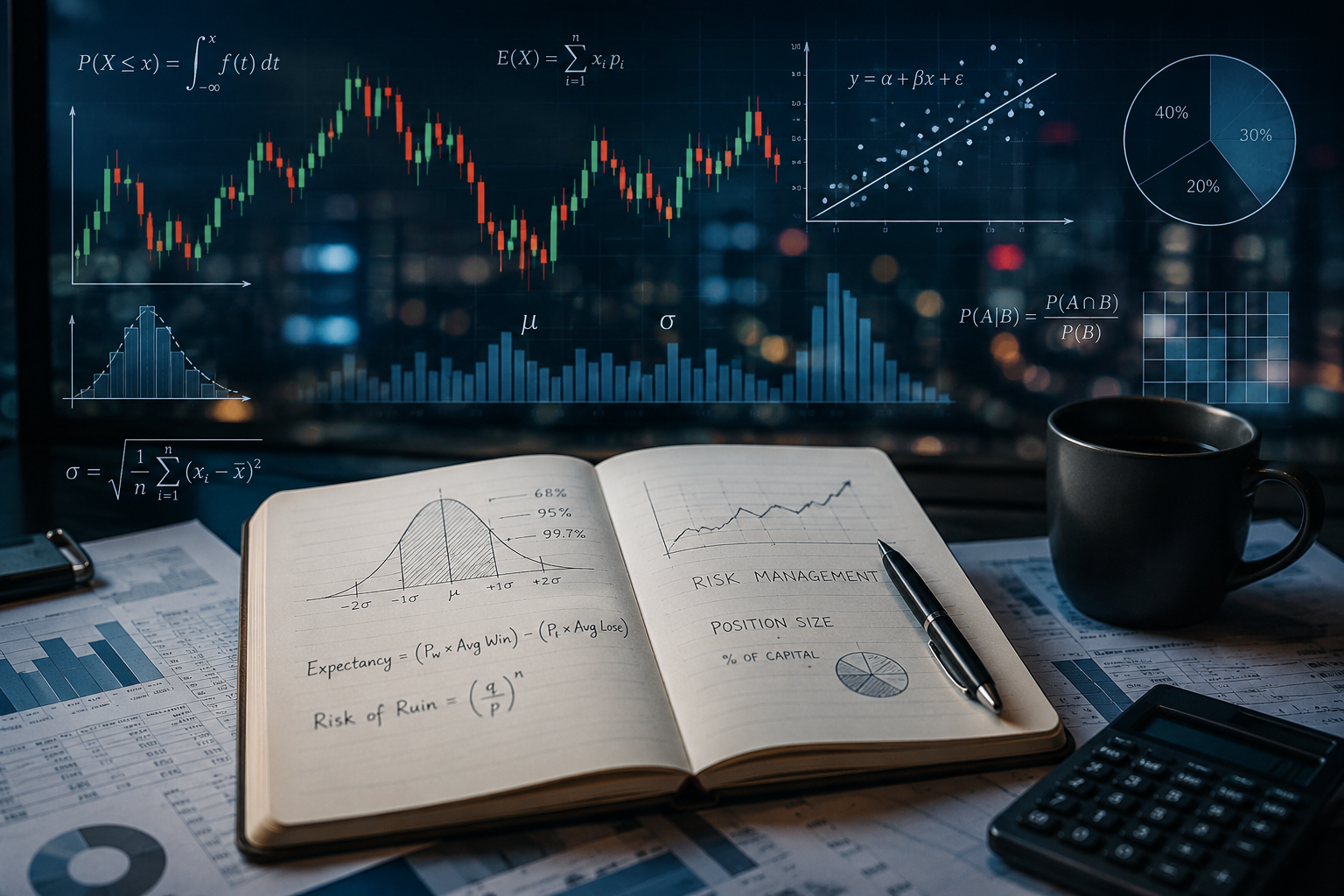
Expectancy = probability of winning multiplied by average win, minus probability of losing multiplied by average loss.
For example, a strategy that wins 45% of the time with an average winner of 3R and an average loser of 1R may be a very strong strategy. On the other hand, a strategy with an 80% win rate but tiny winners and occasional large losses can be extremely dangerous.
This is where many traders fail. They fall in love with being right. But markets do not reward the trader who is right most often. They reward the trader who makes more when right and loses less when wrong.
Overconfidence: the quiet enemy of the trader
A famous study by Brad Barber and Terrance Odean examined 66,465 investor accounts and found that the most active traders significantly underperformed the market. According to the study, the most active traders earned an annual return of 11.4%, while the market returned 17.9%. Their message was direct: excessive trading hurts performance.
In another study, Barber and Odean found that men traded 45% more than women, and that trading reduced men’s net returns by 2.65 percentage points per year, compared with 1.72 percentage points for women. The researchers linked this behavior to overconfidence.
This is uncomfortable but important. Very often, the problem is not lack of knowledge. It is too much confidence in the ability to predict the next move. The trader feels he “sees the market,” so he increases leverage, tightens stops emotionally, adds positions without a plan and takes one trade after another. Psychologically, it feels like control. Statistically, it is usually an increase in risk.
The disposition effect: why we sell winners too early and hold losers too long
One of the most famous behavioral biases in investing is the disposition effect. Shefrin and Statman described in 1985 the tendency of investors to sell winning positions too early and hold losing positions too long.
Terrance Odean later tested this behavior using trading records from about 10,000 accounts and found that investors showed a strong preference for realizing winners rather than losers. According to the study, this behavior was not well explained by portfolio rebalancing, transaction costs or better subsequent performance.
Why does this happen? A realized gain gives us a feeling of success. A realized loss forces us to admit we were wrong. So many traders close good trades too quickly and leave bad trades open for too long. Statistically, that damages expectancy. Emotionally, it feels better in the short run.
Prospect theory: losses hurt more than gains feel good
In 1979, Kahneman and Tversky developed Prospect Theory, one of the most important ideas in behavioral economics. The central idea is that people do not treat gains and losses symmetrically. A loss hurts more than an equal gain feels good. Also, the way risk is framed has a powerful effect on the decision people make.
For traders, this matters enormously. When a position is profitable, the fear of losing the gain pushes us to exit too early. When a position is losing, the pain of realizing the loss pushes us to “give it a little more room.” In other words, instead of statistics managing the trade, emotion manages it.
And that may be the most important sentence in this article: as long as you manage a trade based on emotional pain, you are not really managing risk.
Position sizing: where statistics becomes survival
Even a good strategy can destroy an account if position size is too large. This is one of the key lessons behind the Kelly Criterion, developed by John Kelly in 1956. The original idea was to calculate the optimal bet size when there is a statistical edge, in order to maximize long-term capital growth.
But in real trading, this must be handled carefully. Full Kelly can be too aggressive, especially when our estimates of probability and average payoff are uncertain. That is why many professional traders think in terms of half Kelly, quarter Kelly or simply risking a small fixed percentage per trade.
The message is simple: it is not enough to know where to enter. You must know how much to risk. The great advantage of a professional trader is not that he is always right. It is that he survives long enough for his edge to play out.
How to build statistical thinking in practice
A trader who wants to think statistically must start treating trading as a repeated experiment, not as a series of personal dramas.
First, the setup must be defined clearly. Not “the stock looks good,” but precise conditions: trend, volume, price structure, entry level, stop, target, risk-reward ratio and exit rules.
Second, the trader needs a trading journal. Not only entry and exit prices, but also the reason for the trade, market conditions, risk-reward ratio, position size, whether the trade followed the plan and the result measured in R.
Third, the trader must evaluate series, not individual trades. After 50 or 100 trades of the same type, real questions can begin: what is the win rate? What is the average winner? What is the average loser? What was the maximum drawdown? In which market conditions does the setup work best? Where does it fail?
Fourth, the trader must separate decision quality from outcome. This is one of the hardest disciplines in trading. The market can reward a bad decision and punish a good one. That is why a professional trader judges himself not only by the result, but by the quality of the process.
What this means in day-to-day trading
Statistical thinking changes everything. It makes the trader stop chasing certainty and start working with probability. It forces the trader to stop asking, “Will this trade work?” and start asking, “Does this trade belong to a group of trades that has shown an edge over time?”
It also reduces pressure. If I know my system loses on 45% of trades, then a loss is not a failure. It is part of the system. If I know my average winner is two or three times larger than my average loser, I do not need to be right all the time. I need to execute correctly.
That is the point where trading begins to shift from an emotional game into a profession.
Bottom line
Statistical thinking is not a nice addition to trading. It is the foundation. Without it, the trader remains trapped by short streaks, gut feelings, overconfidence, fear of loss, the need to be right and the illusion of control.
The professional trader understands something deeper: the market does not owe him certainty. He is not trying to know what will happen on the next trade. He is trying to build a process where, over enough trades, his edge has a chance to work.
Good trading is not the ability to predict the future. It is the ability to make good decisions under uncertainty, again and again, without allowing noise, fear or ego to manage the account.
Have a take on this?
Jump into the TradeTechAI Discord to discuss this article with other traders.
Written by
Admin User
Editor
Editor at TradeTechAI, covering market analysis, trading strategies, and portfolio insights.