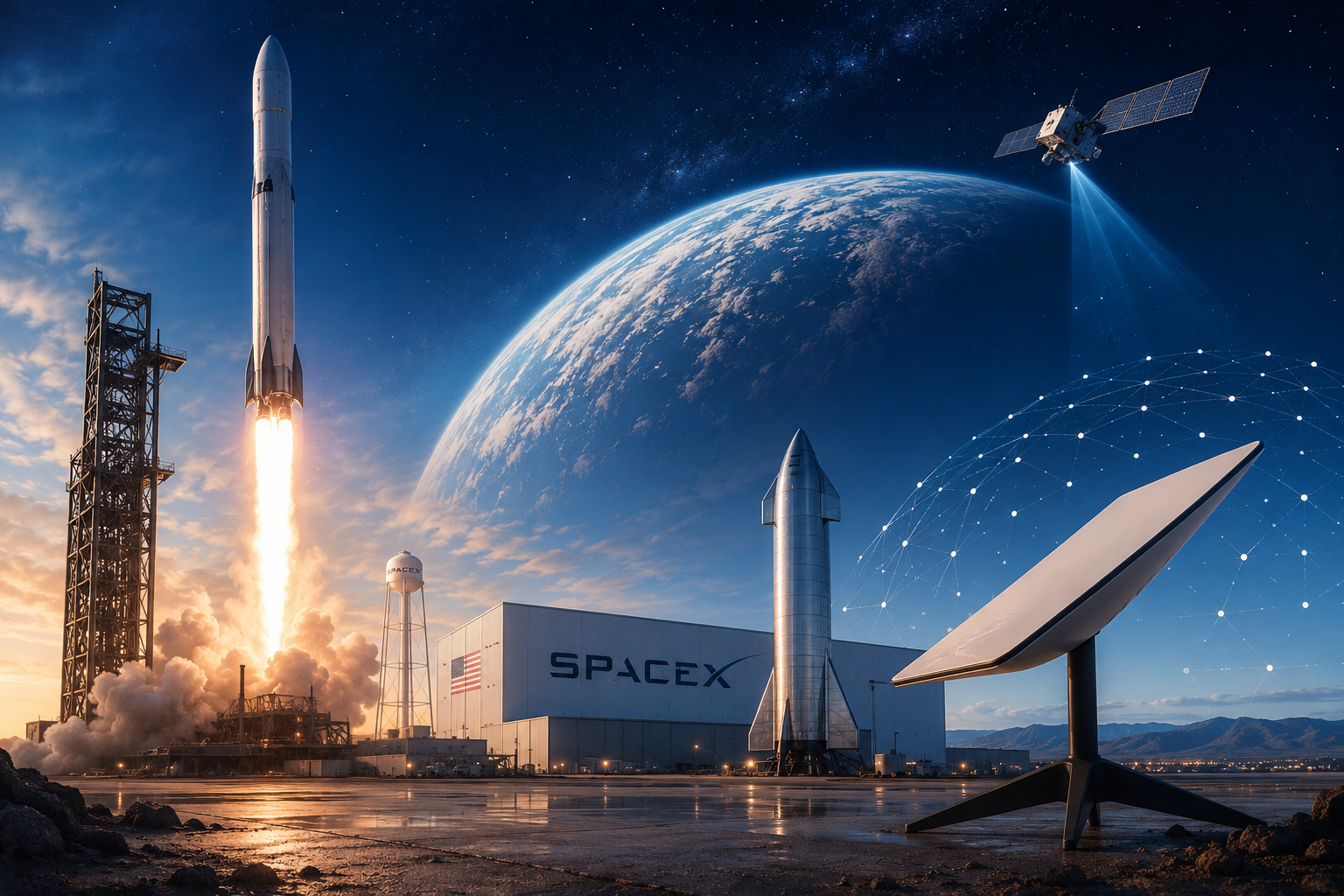
Elon Musk’s space company is expected to begin trading on Nasdaq on Friday under the ticker SPCX. With a planned $75 billion capital raise and a valuation of $1.75 trillion, it could become the largest IPO in history. Behind the excitement, however, lies a difficult question: how much of the valuation is supported by Starlink and SpaceX’s existing businesses, and how much depends on future promises such as Starship, orbital computing and the colonization of Mars?
After years in which ordinary investors searched for indirect ways to gain exposure to the company, SpaceX is preparing to enter the public market.
Under the current timetable, the IPO is expected to be priced on Thursday, June 11, with trading scheduled to begin on Nasdaq on Friday, June 12, 2026, under the ticker SPCX. SpaceX filed its official registration statement with the U.S. Securities and Exchange Commission on May 20. As of publication, the offering has not yet been completed, and the final terms may still change.
An IPO That Could Break Every Record
SpaceX plans to sell approximately 555.6 million shares at a target price of $135 per share. If completed on those terms, the company would raise roughly $75 billion at a valuation of approximately $1.75 trillion.
That would make it the largest stock-market flotation ever completed.
For comparison, Saudi Aramco initially raised about $25.6 billion in its 2019 IPO. SpaceX is seeking nearly three times that amount.
The offering’s size is not merely symbolic. It could affect the broader market. Portfolio managers that want to own SpaceX may need to sell other holdings to make room for it. If the company is quickly added to major indexes, index funds and ETFs could be required to buy billions of dollars of shares.
SpaceX Is Rewriting the IPO Playbook
In a conventional IPO, a company and its underwriters publish a price range. Management then meets investors, collects orders and adjusts the final offering price according to demand.
SpaceX has chosen a different approach.
The company indicated a fixed target price of $135 per share before completing its investor roadshow. This is highly unusual and reflects enormous confidence in demand.
In simple terms, SpaceX is telling investors: this is the price, and those who want to participate will have to accept it.
That approach may work because there is no obvious public-market comparison for SpaceX. No other large listed company combines rocket launches, satellite internet, reusable spacecraft, government contracts, artificial intelligence and plans for orbital computing.
Investor Demand Is Already Enormous
According to Reuters, demand for the offering was approaching four times the number of shares available. In other words, for every share SpaceX intends to sell, investors have placed orders for roughly four shares.
Oversubscription does not guarantee that the stock will rise after trading begins, but it gives SpaceX and its underwriters significant control over the allocation process.
Retail investors may receive a larger role than in a typical blockbuster IPO. Even so, access to the offering does not guarantee an allocation. In heavily oversubscribed deals, retail investors may receive only a small portion of the shares they request, or none at all.
Many investors may therefore be able to buy SpaceX only after the stock begins trading publicly.
What Are Investors Actually Buying?
SpaceX is often described as a rocket company, but its business is much broader.
Starlink
Starlink is SpaceX’s satellite communications network, providing internet services to consumers, businesses, airlines, ships, governments and military customers.
It is one of the company’s most important assets. Unlike launch services, which depend on individual missions and contracts, Starlink produces recurring subscription revenue.
As the customer base expands, Starlink increasingly resembles a combination of a telecommunications company, an infrastructure provider and a technology platform.
Falcon 9 and Falcon Heavy
SpaceX transformed the economics of space launches by developing reusable rockets.
Its ability to land and reuse boosters has reduced launch costs and created a major competitive advantage over traditional aerospace companies.
SpaceX launches commercial satellites, government payloads, missions to the International Space Station and its own Starlink satellites.
Starship
Starship is the company’s most ambitious project. The fully reusable system is designed to transport heavy cargo, satellites, equipment and eventually people to Earth orbit, the Moon and Mars.
If successful, Starship could dramatically lower the cost of transporting equipment into space and create entirely new markets.
However, the program remains technically challenging, has faced substantial delays and has not yet demonstrated the rapid reusability required for SpaceX’s most ambitious plans.
Government and Defense Contracts
SpaceX is an important supplier to the U.S. government, NASA and national-security agencies.
It transports astronauts and cargo, launches government satellites and supplies satellite communications services.
These contracts provide significant revenue and strategic importance, but they also expose the company to regulation, government oversight and changing space and defense budgets.
xAI and Orbital Computing
SpaceX merged with Elon Musk’s artificial-intelligence company xAI in early 2026. Investors are therefore not buying only a space and communications company. They are also gaining exposure to artificial intelligence and the Grok platform.
The combination is central to a new vision being presented to investors: placing AI computing infrastructure and data centers in orbit.
SpaceX says it has a commercially viable path to developing orbital AI computing at scale. The company is aiming to begin demonstration missions by late 2027, while its filing indicated that initial deployments could begin as early as 2028.
Why Build Data Centers in Space?
Global demand for AI computing is growing rapidly. Data centers require enormous amounts of electricity, cooling systems, land and physical infrastructure.
SpaceX’s idea is to place computing systems in orbit, where they could potentially use nearly continuous solar energy and avoid some of the limitations facing terrestrial data centers.
The challenges, however, are enormous:
Launching heavy computing equipment into orbit
Protecting chips from radiation
Dissipating heat in a vacuum
Maintaining and repairing hardware
Establishing fast communications with Earth
Replacing obsolete processors
Reducing launch costs
Achieving reliable and frequent Starship operations
The concept could eventually become revolutionary. At this stage, however, it remains a future opportunity rather than an established commercial business.
Why Does SpaceX Need $75 Billion?
A company as sought-after as SpaceX could probably continue raising capital privately. Its ambitions, however, require extraordinary amounts of money.
The proceeds may be used to expand Starlink, complete Starship development, increase launch capacity, manufacture satellites, build AI infrastructure, purchase advanced chips and fund long-term space projects.
Becoming public also gives SpaceX a valuable new currency. Publicly traded shares can be used for employee compensation, future capital raises and acquisitions.
The IPO will also eventually give employees and early investors greater liquidity for their holdings, subject to lock-up restrictions.
Share Price Is Not the Same as Valuation
A price of $135 per share does not tell investors whether the stock is cheap or expensive.
The relevant figure is the company’s total valuation, approximately $1.75 trillion, compared with its revenue, profits, cash flow and future growth potential.
That valuation would immediately place SpaceX among the largest companies in the world. Investors are therefore not being offered a small company at an early stage. They are paying in advance for a significant portion of its possible future success.
To justify the valuation, SpaceX will need to deliver more than Starlink growth. It will also need substantial progress in Starship, launch services, artificial intelligence and markets that do not yet fully exist.
The Bull Case
SpaceX has several advantages that are difficult to ignore.
It has a strong technological lead in reusable rockets, a globally recognized brand, deep relationships with the U.S. government and a satellite infrastructure network that would be extremely difficult to recreate.
Starlink could become one of the world’s most important communications platforms, particularly in regions where terrestrial networks are unavailable or unreliable.
SpaceX also benefits from vertical integration. It manufactures satellites, launches them on its own rockets, operates the network and sells the service directly to customers.
That integration could give it a durable advantage over competitors that depend on third-party launch providers, satellite manufacturers or communications networks.
The Risks Investors Cannot Ignore
An Extremely High Valuation
A $1.75 trillion valuation reflects extraordinary expectations. Even a remarkable company can become a poor investment when the entry price is too high.
Dependence on Elon Musk
Musk is one of SpaceX’s greatest strengths, but he is also a major risk. He manages several companies and projects, and his political activity and public statements may affect SpaceX’s reputation, customer relationships and regulatory environment.
Starship Has Not Yet Proven the Business Model
A large portion of SpaceX’s future depends on Starship achieving frequent, reliable and low-cost launches.
Delays, technical failures or regulatory restrictions could push back multiple projects simultaneously.
Heavy Capital Requirements
Rockets, satellites, launch facilities, AI chips and orbital infrastructure require massive capital expenditures.
Rapid revenue growth does not necessarily guarantee strong free cash flow.
Regulation and Geopolitics
SpaceX operates in sensitive areas involving communications, national security, infrastructure and space.
Governments may restrict operations, delay licenses or object to the concentration of critical infrastructure in the hands of one company.
Corporate Governance
The planned structure is designed to preserve strong control for Musk and other key shareholders.
That means ordinary public investors may have limited influence over major decisions. Reuters reported that preserving founder control is a central feature of the offering’s governance structure.
What Could Happen on the First Trading Day?
The IPO price and the stock’s opening market price may be very different.
Investors who receive an allocation will purchase shares at the offering price. Nasdaq will then collect buy and sell orders and establish an opening price based on supply and demand.
Given the level of interest, the stock could open well above $135.
That would create an immediate gain for investors who received IPO shares, but it would also increase the risk for those buying after trading begins.
For example, if the stock opens at $180, an investor purchasing at that level is no longer buying SpaceX at a $1.75 trillion valuation. The effective valuation would be roughly one-third higher.
Investors should therefore separate enthusiasm for the company from the price they are actually being asked to pay.
The Broader Market Impact
The SpaceX IPO could draw capital away from technology stocks, space companies, AI investments and even cryptocurrency markets.
Investors seeking cash to participate may sell existing positions. Because of the offering’s size, the impact could extend far beyond SpaceX itself.
Future inclusion in the Nasdaq-100 or other major indexes could create additional automatic demand from passive funds. Reuters has reported that the company has pushed for mechanisms that would accelerate its inclusion in major indexes following the listing.
Should Investors Participate?
There is no universal answer.
A long-term investor must decide whether SpaceX can become one of the world’s most important communications, space and computing infrastructure companies, and whether that future justifies a $1.75 trillion valuation today.
A short-term investor will focus more heavily on demand, allocation size, the opening price and volatility during the first few trading sessions.
In either case, receiving shares at the IPO price is not the same as buying after a large first-day increase.
The Bottom Line
SpaceX is arguably one of the most impressive private companies built in recent decades.
It has transformed the launch industry, created a global satellite communications network and turned ideas that once appeared unrealistic into functioning commercial businesses.
But investors are not being asked to value only the SpaceX that exists today.
The IPO also prices in the SpaceX of tomorrow: a fully operational Starship, millions of additional Starlink customers, orbital data centers, large-scale AI infrastructure and perhaps, eventually, a permanent human presence on Mars.
It is an extraordinary investment story, but it also carries an extraordinary price.
The central question is not whether SpaceX is a great company. The question is whether even a great company can justify a valuation of $1.75 trillion before much of its long-term vision has become reality.
Have a take on this?
Jump into the TradeTechAI Discord to discuss this article with other traders.
Written by
Admin User
Editor
Editor at TradeTechAI, covering market analysis, trading strategies, and portfolio insights.