
When investors think about the growth of the space industry, the first names that usually come to mind are SpaceX, Rocket Lab, AST SpaceMobile and Intuitive Machines. These companies build and launch rockets, satellites and spacecraft, so they naturally receive most of the attention.
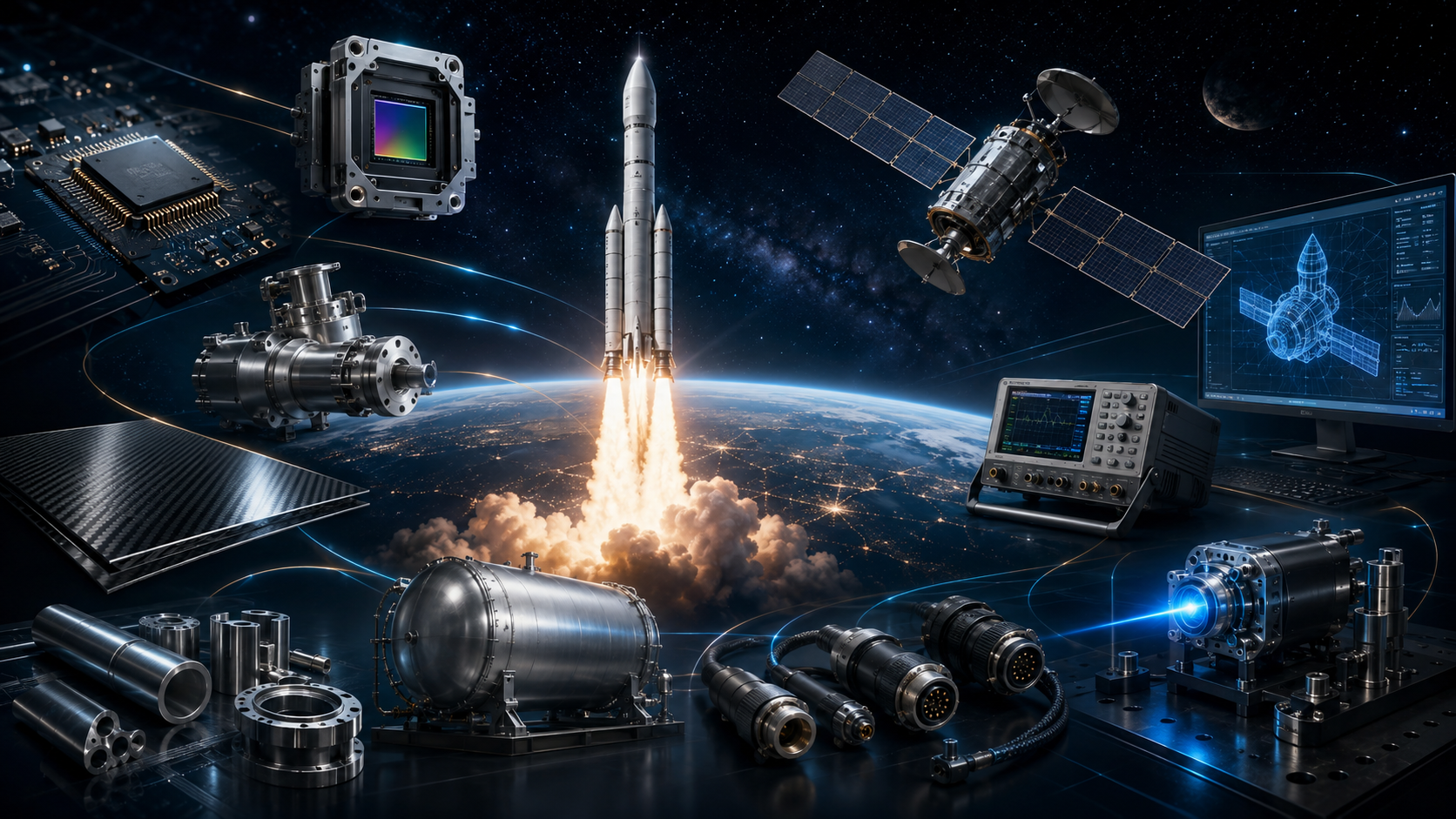
But the space industry cannot grow through the companies at the front of the value chain alone. Behind every launch stands a long network of suppliers providing radiation-hardened semiconductors, imaging sensors, connectors, cables, propulsion controls, specialty alloys, composite materials, cryogenic gases, engineering software and testing equipment.
In many cases, these second and third-circle companies may offer investors a more attractive balance between growth and risk. They do not need to identify the single rocket company that will win. They can sell to several manufacturers, governments, defense agencies and commercial customers at the same time.
The smarter way to participate in the growth of the space economy may therefore be not only to own the company building the rocket, but also the companies producing the critical components that allow it to fly.
Every Satellite Is Becoming a Flying Data Center
The new generation of satellites is very different from the satellites of the past. They do not merely receive a signal and transmit it back to Earth. They capture images, process information, analyze data, manage complex communications, connect with other satellites and increasingly perform tasks autonomously.
As satellites become more sophisticated, demand grows for processors that combine high computing power, low energy consumption and resistance to radiation.
One of the most interesting companies in this field is Microchip Technology, ticker MCHP. The company supplies radiation-hardened and radiation-tolerant processors, memories and FPGA products for missions ranging from low-Earth orbit to deep-space exploration. Its PIC64-HPSC family is designed for advanced space computing, including processing, networking, security and autonomous missions.
Microchip's advantage is not only the technology. Components used in space must pass long and expensive qualification processes. Once a device has been selected for a mission, customers are reluctant to replace it because a single failure could jeopardize the entire project.
The limitation is that space still represents only a relatively small part of Microchip's overall business. Even rapid growth in the sector would not transform the company on its own, but it could become an important long-term growth driver.
Sensors Are the Eyes of the Space Economy
One of the fastest-growing areas of the space economy is data collection. Satellites are now used for Earth observation, weather forecasting, agriculture, defense, mapping, fire detection, pollution monitoring, maritime tracking and infrastructure analysis.
All of these applications require advanced sensors, cameras, infrared detectors and imaging systems.
Teledyne Technologies, ticker TDY, is one of the strongest companies in this area. Its portfolio includes imaging sensors, cameras, infrared detectors and electronic components used in space applications. The company specifically identifies space-based imaging as one of its markets, and its sensors have been deployed in scientific, defense and commercial missions.
Teledyne's exposure is especially attractive because its opportunity does not depend only on the number of launches. Lower launch costs may increase the number of satellites, but the real economic value comes from the information they collect. The more accurate, continuous and useful that information becomes, the greater the need for advanced imaging technology.
A Rocket Needs a Nervous System
A rocket is not simply an engine attached to a fuel tank. It contains valves, actuators, flow-control systems, guidance mechanisms and electromechanical components that control thrust direction, fuel flow and moving parts.
Moog, ticker MOG.A, is one of the leading suppliers in this field. It designs and manufactures systems and components for spacecraft, missiles and launch vehicles, including propulsion systems, valves, fluid controls, avionics and actuation technologies. Its products support chemical, electric and cold-gas propulsion systems, as well as thrust-vector-control systems for launch vehicles.
This is a classic second-circle company. It receives little public attention, but its products are part of mission-critical systems that cannot afford to fail.
For investors, the advantage is diversification. Moog is not dependent on a single customer or one space mission. It also operates in aviation, defense and industrial control. The trade-off is that space is not its only source of revenue.
Lower Weight Improves the Economics of Space
Weight is one of the most important variables in spaceflight. Every additional kilogram requires more fuel, a larger launch vehicle or a reduction in payload. The industry therefore needs materials that are both lighter and stronger.
Hexcel, ticker HXL, is a global leader in carbon fiber, honeycomb structures and advanced composite materials used in aviation, defense and space. Its products are used in applications such as payload fairings, doors, satellite structures and solid rocket booster cases.
As launch activity increases and manufacturers attempt to improve payload efficiency, demand for lightweight materials should continue to grow.
However, Hexcel remains heavily exposed to the commercial aviation cycle. It is not a pure space investment, but rather an aerospace supplier receiving an additional growth opportunity from defense and space.
The Alloys That Allow Rocket Engines to Survive
Rocket engines operate under extreme heat, pressure, cold and vibration. Ordinary steel is not enough. Manufacturers require specialized alloys based on nickel, titanium, cobalt and other advanced materials.
Carpenter Technology, ticker CRS, produces hundreds of specialty alloys, including nickel, titanium and cobalt-based materials. It also develops metal powders and materials used in advanced manufacturing and additive manufacturing.
Additive manufacturing is particularly important in the space industry because it allows manufacturers to produce complex engine components as a single part, reduce the number of welds, lower weight and shorten production times.
Another relevant company is ATI, ticker ATI, which supplies titanium and nickel-based alloys to the aerospace and defense industries. Both companies may benefit not only from space growth, but also from rising defense spending and a stronger aviation cycle.
Not Jet Fuel, but Cryogenic Infrastructure
A common misconception is that rockets use ordinary jet fuel. In reality, launch systems use combinations of liquid oxygen, liquid hydrogen, methane, rocket-grade kerosene, helium and solid propellants.
This creates an opportunity for another group of third-circle companies: industrial gas producers and cryogenic infrastructure providers.
Air Products, ticker APD, supplies liquid hydrogen, helium and other gases to the space industry. In January 2026, it announced contracts worth more than $140 million to supply liquid hydrogen to NASA facilities. The company later reported that it had supplied critical hydrogen and helium for the Artemis II mission.
Linde, ticker LIN, could also benefit from the development of launch sites, test facilities, storage systems, cooling infrastructure and industrial gas networks.
Space will not become the main source of revenue for companies of this size. Nevertheless, they can participate in the infrastructure buildout without depending on the success of a specific rocket manufacturer.
Even Small Connectors Become Mission-Critical
A rocket or satellite contains thousands of electrical connections. Every connector must withstand severe vibration, temperature swings, radiation, vacuum and mechanical stress.
Amphenol, ticker APH, manufactures connectors, cables and communication components for the aerospace and defense industries. Its Amphenol Aerospace division supplies military-grade and customized connectors for harsh environments, including products designed for extreme temperatures and space applications.
TE Connectivity, ticker TEL, operates in similar areas, including connectors, sensors, cables and systems for transmitting power and data.
The value of a connector may appear small relative to the cost of a rocket, but customers cannot tolerate failure. Reliability, qualification and operational history therefore create meaningful competitive advantages.
Every System Must Be Tested
Before launch, every component goes through a long series of tests. Engineers test communications systems, antennas, power systems, batteries, sensors and radio-frequency components.
Keysight Technologies, ticker KEYS, provides software, simulation tools and testing equipment for space and satellite systems. Its solutions cover the development process from design and simulation through verification, manufacturing and payload testing.
As satellites move toward higher frequencies, wider bandwidth and greater electronic complexity, testing becomes more demanding and more valuable.
Keysight can benefit before the satellite ever reaches orbit. Every company developing a new system requires testing equipment, whether the final mission succeeds or not.
The Next Layer: Optical Communications and Chip Design
Future satellite networks are expected to rely increasingly on laser-based links and optical communications. At the same time, they will transmit larger amounts of data to infrastructure on Earth.
Coherent, ticker COHR, supplies optical components, lasers and photonic materials. Space is not currently its main business, but the company could benefit from the development of optical links between satellites and between orbit and the ground.
Further out in the value chain are Cadence, ticker CDNS, and Synopsys, ticker SNPS. As companies design more specialized chips for space, demand should increase for electronic design automation, verification and simulation software.
Space is not the main investment thesis for either company, but it adds another layer to the broader trend of rising chip and system complexity.
Which Companies Offer the Most Interesting Exposure?
Among the second-circle suppliers, the most compelling names are:
Microchip, for radiation-hardened computing and semiconductors.
Teledyne, for imaging, infrared and sensing technologies.
Moog, for propulsion controls, actuation and fluid systems.
Hexcel, for lightweight composite materials.
Carpenter Technology, for specialty alloys and advanced manufacturing.
Among the third-circle beneficiaries:
Air Products, for hydrogen and cryogenic gases.
Amphenol, for connectors and electrical infrastructure.
Keysight, for testing and simulation.
Coherent, for optical and laser components.
Cadence and Synopsys, for chip and electronic-system design.
The Investment Conclusion
Over the next decade, the space economy may evolve from an industry dominated by governments and a small number of major projects into a broad commercial infrastructure supporting communications, navigation, defense, intelligence, computing, sensing and data services.
But not every space company will survive. Many early-stage businesses will need to raise capital repeatedly, manage technical failures, absorb project delays and compete against larger companies with stronger balance sheets.
Second and third-circle suppliers offer a different way to participate in the trend. They sell semiconductors, sensors, materials, gases, connectors and testing equipment to multiple customers. They do not need to predict the eventual winner of the space race. They benefit from the expansion of the race itself.
The biggest winners of the space economy may therefore be not only the companies whose names appear on the rockets, but also the lesser-known suppliers building everything inside them.
Have a take on this?
Jump into the TradeTechAI Discord to discuss this article with other traders.
Written by
Admin User
Editor
Editor at TradeTechAI, covering market analysis, trading strategies, and portfolio insights.