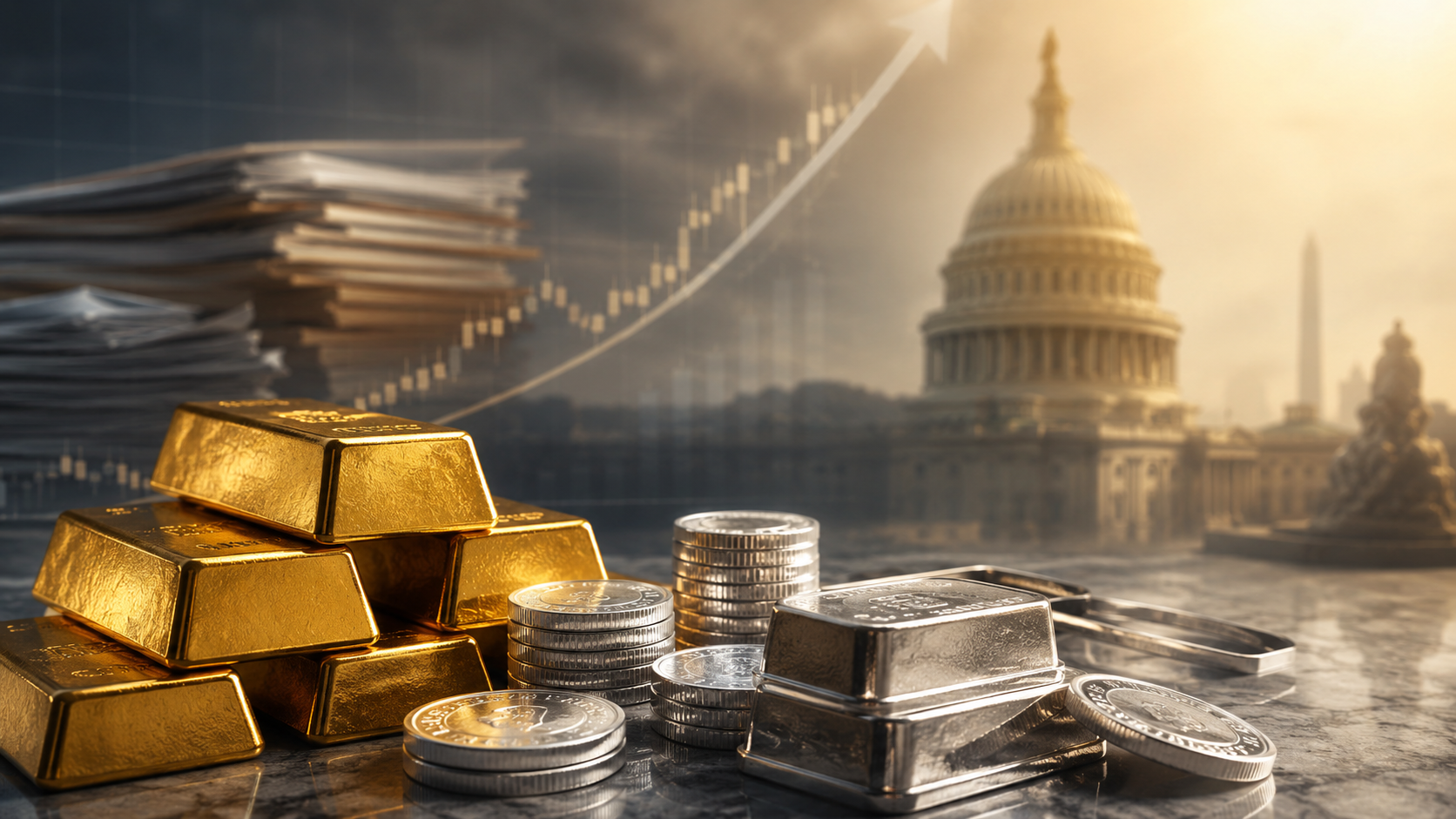
Gold and silver are moving back to the center of the investment conversation. Not only because of inflation, wars or market volatility, but because of a deeper issue: trust. Trust in currencies, trust in governments and trust in the ability of the United States to keep rolling over a massive debt burden without paying a heavy economic price.
U.S. debt is already at extremely high levels and is expected to keep rising in the coming years. When a government carries such a large debt load, the problem is not only the size of the debt itself, but the cost of financing it. The larger the debt and the higher the interest rate, the more interest payments become a major burden on the federal budget. More money goes to servicing debt, while less money is available for investment, services, defense, infrastructure and future growth.
This creates a pressure mechanism that can feed on itself. More debt requires more bond issuance. More bond issuance may require higher yields to attract investors. Higher yields increase interest payments, and higher interest payments increase the deficit. This is a difficult cycle to break without very strong growth, painful spending cuts or a gradual erosion of the value of money.
This is where gold and silver come into the picture. When investors begin to suspect that the most realistic way to deal with the debt is not to repay it fully in real terms, but to erode it over time through inflation, low real interest rates and a weaker dollar, precious metals become highly relevant again.
Gold is first and foremost an asset of trust. It does not pay interest, it does not pay dividends and it does not generate cash flow. But that is exactly what makes it different from ordinary financial assets. It does not depend on a company’s balance sheet, a CEO, a board decision or the ability of a government to meet its obligations. Gold is an ancient monetary asset that becomes more important when individuals, institutions and central banks look for an anchor outside the traditional financial system.
In recent years, central banks around the world have also increased their gold purchases. This does not mean the dollar is disappearing or losing its status overnight. But it does show that the world is looking for diversification. Countries understand the value of holding an asset that is not someone else’s liability, especially in a world where debt, sanctions and geopolitics are becoming more important.
Silver is part of the same story, but it has another feature that makes it especially interesting. On one hand, it is a monetary metal like gold. On the other hand, it is also an important industrial input. Silver is used in solar panels, electronics, electric vehicles, medical equipment, conductors, batteries and defense applications. So if gold benefits from concerns over debt, inflation and currency debasement, silver may benefit from both the monetary story and the industrial demand story.
Silver is also a much smaller market than gold. That means when significant capital starts flowing into the sector, price moves can be sharper. This is exactly why silver is often seen as gold’s smaller and more volatile brother. It can rise faster during periods of momentum, but it can also fall harder when markets come under pressure.
One of the most important indicators for investors in this space is the gold-to-silver ratio. This ratio measures how many ounces of silver are needed to buy one ounce of gold. When the ratio is very high, silver is relatively cheap compared with gold. When the ratio begins to fall, it may signal that silver is closing the gap and sometimes even beginning to outperform gold.
In a positive scenario for precious metals, U.S. debt continues to rise, the deficit remains high, interest payments weigh heavily on the budget and the Federal Reserve finds it difficult to keep interest rates high for too long. If real interest rates fall and the dollar weakens at the same time, this could create a very supportive environment for gold and silver. Gold may continue to act as monetary insurance, while silver may become the more volatile and leveraged version of the same idea.
But it is important to be honest: high debt alone does not guarantee higher gold or silver prices. If the dollar strengthens, real yields rise, inflation clearly declines and the market believes the Federal Reserve is fully in control, precious metals can definitely correct. They do not move in a straight line, and even in bull markets there can be sharp pullbacks.
Silver is riskier than gold in this sense because it is also sensitive to the economic cycle. If the global economy slows, industrial demand for silver may weaken. That is why silver can be very attractive in a scenario where precious metals rise while industrial activity remains strong, but it is also more volatile and requires careful risk management.
For investors, the simplest way to gain exposure is through ETFs. In gold, the most familiar ETFs are GLD and IAU, which provide relatively simple exposure to the price of gold. In silver, the main ETF is SLV, which gives exposure to the price of silver. Beyond that, investors can also look at mining stocks, but it is important to understand that this is a very different story.
Mining stocks are not gold and they are not silver. They are companies. They have management teams, debt, production costs, country risk, mine risk, regulation, potential dilution and exposure to the stock market. When the metal price rises, mining stocks can rise much more than the metal itself. But when the metal price falls or operational problems appear, they can also fall much more sharply.
That is why, in my view, gold is more suitable for investors looking for protection, relative stability and monetary insurance. Silver is more suitable for investors who are willing to accept higher volatility in exchange for higher potential upside, especially if the precious metals story combines with strong industrial demand.
At the end of the day, gold and silver are not just commodities. They are indicators of trust in the system. When U.S. debt rises, interest payments surge and the political ability to reduce deficits is questionable, investors start looking for assets that cannot be printed.
This does not mean investors should chase every rally. It does mean that gold and silver are becoming a more important part of the global investment conversation, especially in a world where debt, interest rates, inflation and a weaker dollar may become one of the main stories of the coming years.
Key takeaway: When debt becomes too large and interest becomes too expensive, gold and silver stop being just metals and become insurance on trust.
Have a take on this?
Jump into the TradeTechAI Discord to discuss this article with other traders.
Written by
Admin User
Editor
Editor at TradeTechAI, covering market analysis, trading strategies, and portfolio insights.