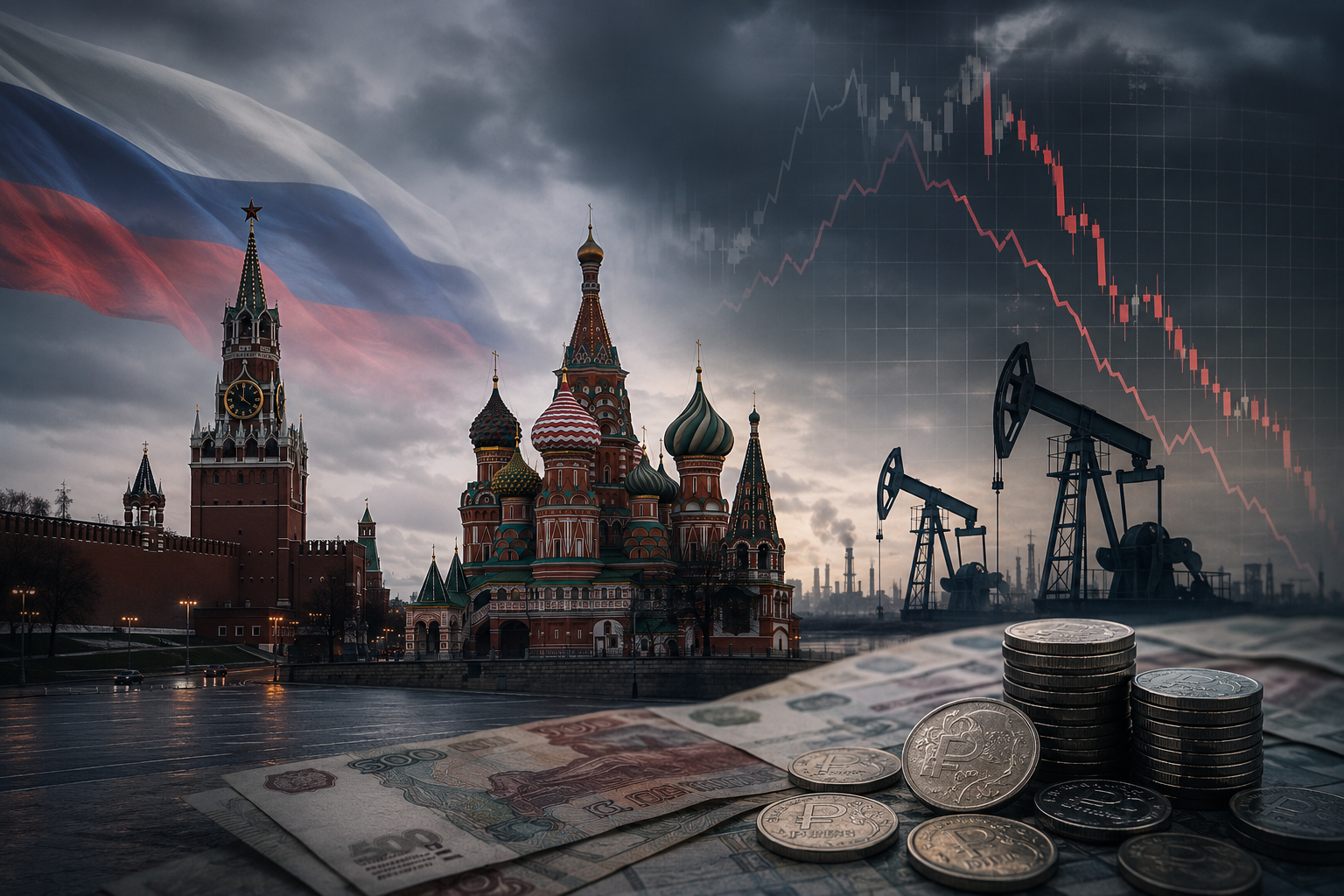
When Russia invaded Ukraine in February 2022, many expected Western sanctions to trigger a rapid economic collapse. Russian banks were cut off from parts of the international financial system, a significant portion of the central bank’s foreign reserves was frozen, foreign companies withdrew, and access to Western technology, industrial equipment and markets was sharply reduced. The ruble initially plunged, households rushed to withdraw funds, and forecasts pointed to a deep recession.
The collapse, however, never came. Russia stabilized its currency through high interest rates, capital controls and rules requiring exporters to convert part of their foreign-currency revenues into rubles. At the same time, high energy prices continued to generate foreign income, while oil previously sold mainly to Europe was redirected toward China, India, Turkey and other markets.
Following a relatively moderate contraction in 2022, the Russian economy returned to growth in 2023 and 2024. On the surface, this appeared to be a major success: sanctions had not crippled the economy, unemployment had fallen and wages were rising. Beneath those figures, however, a very different economy was taking shape.
The war itself became the principal engine of growth. Defense factories shifted to round-the-clock production, output of ammunition, missiles, drones, military vehicles and related equipment expanded, and the government directed enormous sums toward military contracts, soldiers’ wages and compensation for their families. This spending adds to GDP, creates jobs and channels money into industrial regions, but it does not necessarily build future wealth.
A tank contributes to GDP when it is produced, just as a machine built for a civilian factory does. The difference is that the machine may generate goods and income for many years, while the tank may be sent to the battlefield and destroyed. A significant portion of Russia’s growth is therefore accounting growth serving the war effort rather than improving living standards or future productive capacity.
Military spending has become an enormous part of the federal budget and a significant share of the economy. In the short term, it has created strong demand for workers, materials, transportation and industrial output. Over the longer term, however, it crowds out investment in healthcare, education, infrastructure and civilian innovation. The state has increasingly become the country’s dominant customer, investor and employer, while large parts of the private sector depend on government contracts and political decisions.
One of the most serious problems created by this model is a severe labor shortage. Russia is not suffering from high unemployment. In fact, unemployment has fallen to exceptionally low levels. Hundreds of thousands of young men have been mobilized, others have been killed or injured, and many skilled and educated workers left the country after the war began. At the same time, Russia’s population is aging and its labor pool is shrinking.
This has created intense competition for engineers, technicians, drivers, programmers, factory employees and construction workers. Defense companies can offer higher wages because of government funding, pulling workers away from civilian industries. Wages are rising, but not always because productivity has improved. In many cases, they are rising simply because there are not enough people available.
When wages grow faster than production capacity, inflationary pressure follows. The government is injecting large amounts of money into the economy, demand is increasing, but the supply of civilian goods and services cannot expand at the same pace. More expensive imports, shortages of spare parts and the need to route products through third countries add further pressure.
To contain inflation, the Bank of Russia raised interest rates to exceptionally high levels. Expensive credit weighs on mortgages, consumer spending, construction and private investment. Small businesses and civilian companies find it difficult to borrow and expand, while defense industries often receive subsidized funding and guaranteed state contracts.
Russia has therefore developed a two-speed economy. On one side is the war economy, supported by public demand, large budgets and near-full employment. On the other side is the civilian economy, struggling with high financing costs, rising expenses, worker shortages and limited access to technology and capital.
Oil and gas still hold much of the system together. Russia has managed to continue exporting energy despite European restrictions, but on less favorable terms. Some oil is sold at a discount, shipping and insurance costs are higher, and the trade increasingly relies on complex networks of intermediaries, third countries and a so-called shadow fleet of tankers.
The shift from Europe to Asia prevented a much deeper collapse in revenue, but it also changed the balance of power. China and India know that Russia has fewer alternative buyers and therefore possess greater bargaining leverage. Russia can still sell oil and gas, but it is increasingly dependent on a smaller group of buyers and on conditions that may not favor Moscow.
The greatest geopolitical economic shift has taken place in Russia’s relationship with China. Before the war, Europe was Russia’s most important trading partner and a major supplier of machinery, vehicles, advanced technology and industrial equipment. China now fills much of that gap. Russia exports energy and raw materials to China and imports vehicles, electronics, machinery and components.
But this is not an equal partnership. China’s economy is far larger, more diversified and technologically stronger. China has many potential energy suppliers, while Russia increasingly needs the Chinese market, Chinese equipment and access to Chinese financial channels. Russia did not become economically independent. It replaced broad dependence on the West with deeper and more concentrated dependence on China.
Whether sanctions have failed depends on how success is defined. They did not overthrow the Russian government, end the war or prevent Russia from producing weapons and exporting energy. They did, however, make almost every form of economic activity more expensive and complicated. Western equipment arrives through indirect routes, spare parts are purchased through third countries, foreign investment has declined, and access to capital, software, expertise and advanced technology has been damaged.
The deeper effect of sanctions is not necessarily a sudden collapse in GDP. It is the gradual erosion of productivity, technological quality, competition and long-term growth potential. A factory may continue operating with alternative and less advanced components, but over time the technology gap widens and the cost of producing each unit rises.
The ruble is also no longer a completely free market signal. Its exchange rate is influenced by capital controls, government rules, exporter conversion requirements and high interest rates. A temporary strengthening of the ruble therefore does not necessarily indicate that global investors have regained confidence in the Russian economy.
For Russian households, the picture is complicated. Some groups have benefited economically from the war: soldiers receiving high pay and bonuses, families receiving compensation, defense workers and employees in logistics, construction and manufacturing. In some poorer regions, military recruitment payments can equal several years of local wages.
At the same time, inflation is eroding incomes, credit is expensive, cars and electronics cost more, product choice has narrowed and civilian public services are competing with military spending. Russians are not experiencing the war economy in the same way. Some benefit from government money, while others bear the cost through higher prices, high interest rates and weaker public services.
Following strong growth in 2023 and 2024, signs of slowdown have become increasingly visible. The initial impact of military stimulus is fading, high interest rates are weighing on economic activity, labor shortages are limiting production capacity and energy revenues have become more volatile. The war economy succeeded in keeping Russia afloat, but it cannot generate rapid growth indefinitely.
Russia is not necessarily on the verge of collapse. It still possesses enormous natural resources, relatively low government debt, a financial system controlled by the state and the ability to impose restrictions on companies and households. As long as it can sell energy, collect taxes and borrow domestically, it can continue financing the war.
But avoiding collapse is not the same as having a healthy economy. The larger risk is prolonged erosion: weak growth, elevated inflation, restrictive interest rates, declining productivity, demographic shortages and growing dependence on both the state and China.
Russia absorbed the initial shock and surprised those who expected a rapid breakdown. Yet the price was a fundamental transformation of its economic structure. It has become an economy producing more weapons while investing less in its civilian future.
Have a take on this?
Jump into the TradeTechAI Discord to discuss this article with other traders.
Written by
Admin User
Editor
Editor at TradeTechAI, covering market analysis, trading strategies, and portfolio insights.