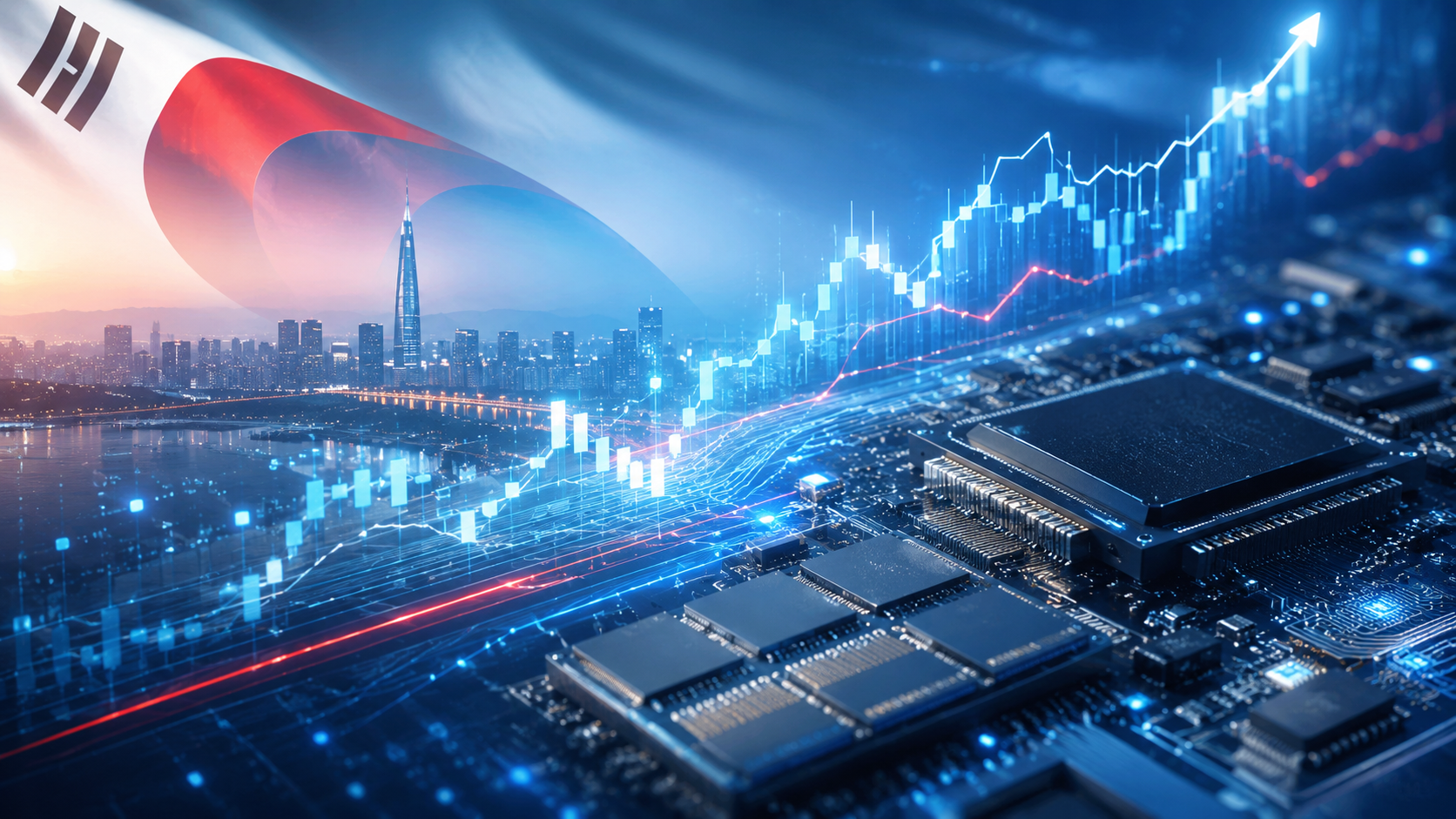
Samsung, SK Hynix and the Memory Race Driving the Artificial Intelligence Revolution
South Korea’s stock market has undergone a dramatic transformation in recent months. For years, Seoul was viewed as a relatively inexpensive, industrial and highly cyclical market. Korean corporations built impressive global businesses, yet their shares often traded at substantial discounts to comparable companies in the United States and Taiwan.
Artificial intelligence has begun to change that perception.
Samsung Electronics and SK Hynix are no longer viewed simply as cyclical producers of memory chips for computers and smartphones. They have become central components of the global AI infrastructure. The high-speed memory they manufacture is essential for Nvidia accelerators, hyperscale data centers and the training and operation of advanced AI models.
The result has been an extraordinary rally in Korean semiconductor stocks. By early July, Samsung had gained more than 130% since the beginning of the year, while SK Hynix had surged more than 220%. Their performance helped the KOSPI rise more than 80% in 2026 before a sharp correction began in late June.
The gains, however, have not come in a straight line. Volatility has become a defining feature of the market. Semiconductor shares have recently suffered sharp declines even after companies reported exceptionally strong results.
This shows how elevated expectations have become. Investors no longer want companies merely to grow. They want them to exceed increasingly aggressive forecasts every quarter.
Memory Has Become the Bottleneck of the AI Revolution
When investors discuss artificial intelligence, most attention goes to Nvidia’s graphics processors and advanced AI accelerators. Yet even the most powerful processor cannot operate efficiently without fast memory.
AI systems must transfer enormous volumes of data between memory and processors. As models become larger and more complex, they require greater bandwidth and faster access to information.
This is where High Bandwidth Memory, or HBM, becomes critical.
HBM is built by stacking multiple layers of memory and connecting them in a way that allows data to move at extremely high speeds. It is more expensive and technically difficult to manufacture than conventional memory, but it has become an essential component of AI accelerators.
Demand for HBM is increasing much faster than production capacity. Major customers are making long-term commitments and reserving future supply years in advance.
Micron’s latest results reinforced expectations that demand remains well above supply and that tight conditions in advanced memory may continue beyond 2027.
This represents an important change for investors. Memory has historically been one of the world’s most cyclical industries. When demand rose, producers rapidly expanded capacity, prices collapsed and profits disappeared.
This time, producers are attempting to remain more disciplined. They are directing capital toward HBM and other high-value products, signing long-term agreements and avoiding uncontrolled capacity expansion.
If this model continues, the current memory cycle may prove longer and more profitable than previous cycles.
SK Hynix: The Leader in HBM
SK Hynix has become one of the largest beneficiaries of the artificial intelligence revolution.
The company has built a major technological lead in HBM and is considered a key supplier to Nvidia and other developers of AI accelerators. In the first quarter of 2026, SK Hynix held approximately 58% of global HBM revenue. Samsung and Micron each held roughly 21%.
Its advantage is not based solely on production volume. It reflects manufacturing yields, product quality, advanced packaging, customer relationships and the ability to deliver new generations of memory quickly.
SK Hynix was among the first companies to produce HBM3E at scale and is now expanding HBM4 production. The company says it was the first to bring HBM4 into mass production, with twice the number of input-output lanes compared with the previous generation.
In the first quarter of 2026, SK Hynix reported revenue of approximately 52.6 trillion won and operating profit of about 37.6 trillion won. These results demonstrate extraordinary profitability for a company that was once heavily dependent on conventional DRAM and NAND pricing cycles.
For comparison, SK Hynix generated approximately 97.1 trillion won in revenue and 47.2 trillion won in operating profit for the entire year of 2025. The first quarter of 2026 alone therefore approached the operating profit achieved during an exceptionally strong full year.
SK Hynix’s Nasdaq Listing
One of the most significant capital-market events for South Korea was the U.S. listing of SK Hynix.
The company began trading on Nasdaq on July 10, 2026, on a when-issued basis under the symbol SKHYV. Regular trading began on July 13 under the permanent ticker SKHY.
The offering used American Depositary Receipts, or ADRs, which represent economic interests in the company’s Korean-listed shares. The structure allows U.S. investors to buy SK Hynix directly in dollars and during American trading hours.
The company raised more than $26 billion. The ADRs were priced at $149, opened near $170 and finished the first session 12.8% above the offering price.
The listing is significant for reasons beyond the amount of capital raised.
First, it gives the company access to a broader base of institutional and retail investors who do not actively trade on the Korean exchange.
Second, it may help reduce the valuation discount commonly applied to Korean companies relative to U.S. peers. Investors can now compare SK Hynix more directly with Micron, Nvidia, Broadcom and other Nasdaq-listed companies.
Third, the listing should improve liquidity, analyst coverage and the company’s visibility among technology and artificial-intelligence funds.
A U.S. listing does not eliminate risk, however. It may actually increase volatility because the stock will respond simultaneously to trading in Korea and the United States, currency movements and rapidly changing expectations regarding the AI sector.
Why Did SK Hynix Fall After the Listing?
Following its strong Nasdaq debut, SK Hynix shares in Seoul fell as much as 8.2% on July 13.
The decline did not reflect a collapse in AI demand. It was driven by a combination of profit-taking and expectations that had become extremely demanding. Some investors had purchased the stock ahead of the U.S. listing and sold once the event was completed.
Analysts also expressed concern that the increase in HBM4 shipments during the second quarter was smaller than expected.
In addition, SK Hynix’s greater exposure to HBM and lower relative exposure to conventional DRAM could mean it benefits less than Samsung when traditional memory prices rise sharply.
This is an important lesson for investors. A company can lead its market, generate exceptional profits and possess superior technology, yet its shares may still decline when the market has already priced in an almost perfect future.
Samsung: The Giant Reawakens
Samsung is a very different company from SK Hynix.
SK Hynix is primarily a memory producer. Samsung is a vast technology conglomerate with operations in semiconductors, smartphones, displays, consumer electronics, contract chip manufacturing and several other businesses.
This diversification provides stability, but it can also make it more difficult for investors to gain pure exposure to the HBM story.
In the first quarter of 2026, Samsung reported record revenue of 133.9 trillion won and operating profit of 57.2 trillion won. Revenue in its Device Solutions semiconductor division increased 86% from the previous quarter, while the memory business achieved record revenue and operating profit.
In its preliminary second-quarter guidance, Samsung projected a nineteen-fold increase in operating profit compared with the same period a year earlier. Despite the remarkable result, the shares fell nearly 7% on the day of the announcement.
The negative reaction shows that the market is no longer satisfied with strong numbers alone. After a gain of more than 130% since the beginning of the year, investors want to know whether current earnings can be sustained, whether Samsung is closing the HBM gap with SK Hynix and whether its foundry business can become more profitable.
Samsung’s Potential Advantage
Although SK Hynix currently leads the HBM market, Samsung has several important advantages.
It possesses enormous production capacity, deep financial resources and an integrated business model that includes memory, chip manufacturing, advanced packaging and finished products.
If Samsung improves manufacturing yields and expands HBM4 supply, it may be able to close the gap with SK Hynix quickly.
Samsung may also benefit more from rising conventional DRAM prices. As memory producers shift capacity toward HBM, shortages can develop in standard memory used in servers, computers and smartphones. This raises prices and improves profitability across Samsung’s broader memory portfolio.
For this reason, some investors view Samsung as the more balanced investment. It may not currently be the pure HBM leader, but it has broader exposure to the entire memory cycle.
Why Has the Korean Market Become So Volatile?
The 2026 rally transformed South Korea from one of the world’s cheapest markets into one of its hottest.
When Samsung and SK Hynix rise together, their large index weights pull the entire KOSPI higher. The same concentration works in reverse during a decline.
On July 7, the KOSPI fell 4.9% after losing more than 8% intraday and triggering a temporary trading halt. Samsung declined 6.9% and SK Hynix lost 6.1%. The index was still up 82% for the year, but had already fallen 16% from its June 22 record.
The numbers show a market moving between optimism and fear within a matter of days.
Retail investors have played a major role in the rally. Margin borrowing used to purchase KOSPI shares approached a record, and domestic investors bought aggressively during the selloff. Foreign investors, meanwhile, sold approximately 2.9 trillion won of shares on July 7.
When a market is driven by leverage, concentration and elevated expectations, relatively small changes in forecasts can produce extremely large price movements.
Is Memory Still a Cyclical Industry?
The central debate surrounding Samsung and SK Hynix is whether the memory market has undergone a structural change or whether this is simply another strong cycle that will eventually end in oversupply.
The bullish argument is that AI has permanently changed demand. Each new generation of accelerator requires more HBM, more bandwidth and more memory. Data centers cannot simply purchase additional processors. They must also acquire large volumes of advanced memory.
HBM is also more complex to manufacture, consumes more production capacity and often has lower yields than conventional memory. Supply therefore cannot be increased as quickly as traditional DRAM capacity was expanded in the past.
The cautious argument is that semiconductor history is filled with periods when shortages turned into oversupply. High prices attract investment, new factories are built and customers search for ways to reduce consumption and improve efficiency.
Cloud providers may also slow capital spending if they fail to generate sufficient returns on their enormous AI infrastructure investments.
The key question is therefore not whether AI demand will continue to grow. It probably will. The question is whether demand will grow quickly enough to justify the prices, investments and equity valuations already built around the industry.
What Should Investors Monitor?
The first metric is the growth rate of HBM3E and HBM4 shipments. Product announcements are not enough. Investors need evidence of mass production, strong yields and actual revenue.
The second metric is conventional DRAM and NAND pricing. Continued price increases could be particularly supportive for Samsung, while weakness in traditional memory could increase SK Hynix’s dependence on HBM.
The third metric is capital expenditure. New semiconductor facilities cost tens of billions of dollars. If companies expand too aggressively, free cash flow may weaken and the risk of future oversupply will increase.
The fourth metric is customer concentration. Heavy reliance on Nvidia is an advantage while Nvidia is growing rapidly, but it also creates risk. Greater exposure to accelerators developed by Google, Amazon, Microsoft and other chip companies would reduce that concentration.
The fifth metric is valuation. After gains of several hundred percent, even an outstanding company can become a risky investment if the share price assumes perfect growth for many years.
How Can Investors Gain Exposure?
The most direct way for an American or Israeli investor to gain exposure to SK Hynix is now through the new Nasdaq ADR under the symbol SKHY.
Samsung remains primarily listed in South Korea, although investors can gain exposure through exchange-traded funds focused on South Korea or emerging markets.
An ETF such as EWY offers broad exposure to the Korean market, but investors should understand that a large portion of its performance is influenced by Samsung and SK Hynix.
Investors seeking broader semiconductor exposure may use funds such as SOXX or SMH, although these are more heavily weighted toward American and Taiwanese companies and provide more limited exposure to South Korea.
The Bigger Picture
South Korea has become one of the most important arenas in the artificial intelligence revolution.
The United States leads in chip design and cloud platforms. Taiwan leads in advanced semiconductor manufacturing. The Netherlands controls critical areas of chipmaking equipment. South Korea dominates much of the memory required to make the entire system function.
SK Hynix is currently the clear leader in HBM. Samsung is the giant attempting to close the gap while also benefiting from a broader increase in memory prices.
SK Hynix’s Nasdaq listing may turn the company into a much more prominent name in global investment portfolios. It also signals a change in how investors view the Korean market.
South Korea is no longer merely a low-valued industrial market at the edge of global technology. It is one of the most important centers of AI infrastructure.
After such dramatic gains, however, the risks are also greater. Industry fundamentals remain strong, but share prices already reflect a substantial amount of optimism. From this point forward, the market will demand near-perfect execution.
Have a take on this?
Jump into the TradeTechAI Discord to discuss this article with other traders.
Written by
Admin User
Editor
Editor at TradeTechAI, covering market analysis, trading strategies, and portfolio insights.