

The Tel Aviv Stock Exchange has gone through a dramatic transformation over the past two years. A market that was once priced at a deep discount, under political, security and economic pressure, has become a market that is once again attracting local investors, institutions and foreign capital. Equity indices reached new highs, trading volumes jumped, companies returned to the capital market, and financials, defense-related companies and technology became the main engines of the rally.
But after such a strong move, the key question is no longer whether the Israeli market is cheap. The real question is whether future earnings can justify the new price levels.
In 2025, the TA-35 index rose 51.6%, while the TA-90 gained 46.6%, a very strong performance even compared with global markets. According to TASE’s 2025 annual review, the leading indices in Tel Aviv reached new highs many times during the year, supported by renewed investor confidence, strong capital raising and the strength of financial and defense-related sectors.
The beginning of 2026 continued to show a stronger and more liquid market. In the first quarter of 2026, the average daily equity trading volume reached about NIS 5.6 billion, up 92% from the same quarter a year earlier. Equity capital raised reached NIS 10.6 billion, an increase of 255% year over year. These numbers show that the rally was not just a move on the chart, but a real recovery in capital-market activity.
The most important part of the story is valuation. At the end of 2023, the Israeli market was very cheap compared with both its own history and global markets. The TA-125 traded at a P/E ratio of around 11.4, reflecting fear, war, high interest rates and a deep Israel discount. Today, the picture is very different. According to MSCI Israel, the market trades at a P/E ratio of around 15.36 and a forward P/E of around 13.22. According to the iShares MSCI Israel ETF, the P/E ratio is around 15.82. In other words, Israel is no longer trading at crisis multiples. It is now priced for continued earnings growth.
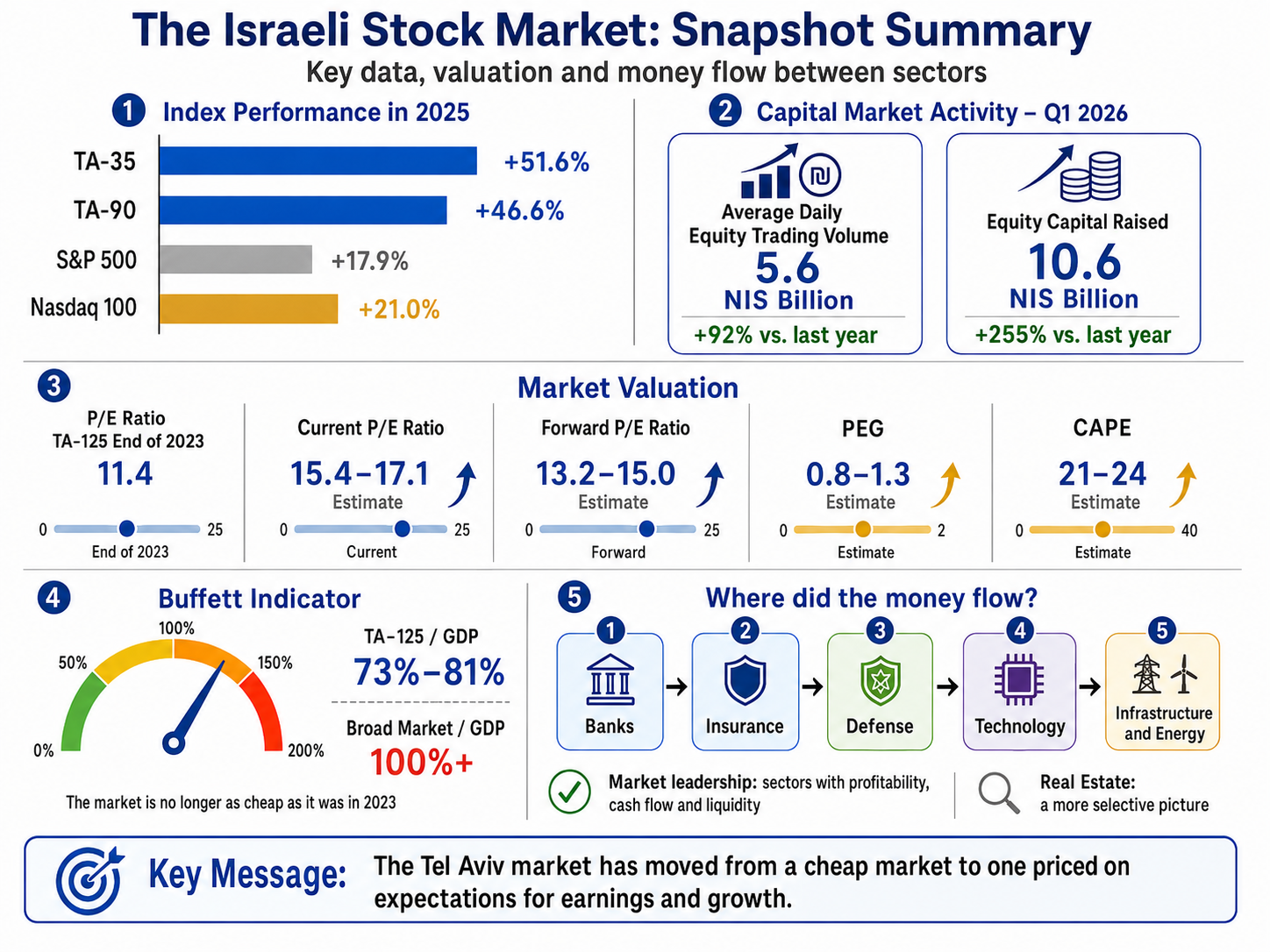
Broader estimates point in the same direction. World PE Ratio estimated the Israeli market’s P/E at about 17.11 in early July 2026, compared with a five-year average range of about 9.9 to 14.2. The message is clear: the Israeli market has become significantly more expensive relative to its own recent history.
However, this does not automatically mean that the market is in a bubble. A more expensive market is not necessarily an irrational market. If corporate earnings continue to grow, a forward P/E of 13 to 15 can still be reasonable. The problem is that the market now needs proof. In 2023, it was enough to say that the market was cheap. In 2026, investors need to ask which companies are truly growing earnings, which stocks simply rose with the index, and where future growth really justifies the valuation.
This is where PEG and CAPE become important. PEG, which divides the P/E ratio by expected earnings growth, can still look reasonable if earnings grow at a double-digit rate. In a positive scenario, Israel’s market PEG may be around 0.8 to 1.0. In a more conservative scenario, where earnings growth slows, it could rise toward 1.3 to 1.7. This means that, based on PEG, the market is not necessarily too expensive, but it is highly dependent on continued earnings growth.
The Shiller CAPE ratio is more complicated in Israel because there is no official CAPE index for the TA-125. Still, if we normalize earnings over the past decade, especially given the unusually strong profitability of banks, insurance companies and defense-related firms, a reasonable estimate for Israel’s CAPE would be around 21 to 24. That is high relative to local history, although still well below the levels seen in the U.S. market.
The Buffett Indicator, total market capitalization relative to GDP, supports the same conclusion. If we look only at the TA-125, the ratio to Israel’s annual GDP is elevated but not extreme. If we look at the broader equity market, including dual-listed companies, the ratio approaches or may even exceed 100%. This suggests that the Tel Aviv market is no longer priced like a small, cheap market. It has been re-rated.
One of the most important stories is sector rotation. Money did not flow into the entire market equally. Banks, insurance companies, defense-related stocks, technology and infrastructure attracted most of the attention. The reason is simple: these are the sectors where investors saw a combination of profitability, cash flow, liquidity and a clear macro story.
Banks benefited from higher interest rates, wider credit spreads and strong returns on equity. Insurance companies benefited from higher premiums, improved loss ratios, strong capital markets and the implementation of IFRS 17, which made core insurance profitability more visible. Defense-related companies benefited from rising global demand for security, advanced technology and defense equipment. Local technology gained support from the global AI, cybersecurity and semiconductor trends.
Real estate is a more complicated story. In the past, Israeli real estate stocks were broad beneficiaries of low rates and cheap leverage. Today, the market is much more selective. Companies with high-quality assets, reasonable leverage and stable cash flows remain attractive. More leveraged companies, or those that depend on expensive debt refinancing, are receiving a larger discount.
Interest rates in Israel remain a major factor. In May 2026, the Bank of Israel lowered the interest rate to 3.75% and stated that the future rate path would depend on inflation, economic activity, geopolitical uncertainty and fiscal developments. Lower rates can continue to support equities, bonds and real estate, but if inflation or security risks return, the market could quickly reprice risk.
For investors, the conclusion is not “buy everything” and it is not “run away from the market.” The conclusion is that the Tel Aviv Stock Exchange has moved from a deep-discount phase to a more selective phase. In 2023, broad value could be found across the market. In 2026, investors need to separate companies whose earnings justify the rally from companies that simply benefited from the general wave.
The sectors that can still lead are those with real profitability and clear growth: banks, insurance, defense-related companies, infrastructure, energy and parts of technology. The main risk is in areas where share prices rose faster than earnings, or in stocks where the story is attractive but the valuation leaves very little room for error.
In the end, the Tel Aviv market no longer looks like a market in crisis. It looks like a market that has been re-rated, with more liquidity, more interest and more capital, but also with a smaller margin of safety. It can continue to rise, but it can no longer rely only on closing a discount. From here, earnings will have to do the talking.
Have a take on this?
Jump into the TradeTechAI Discord to discuss this article with other traders.
Written by
Admin User
Editor
Editor at TradeTechAI, covering market analysis, trading strategies, and portfolio insights.