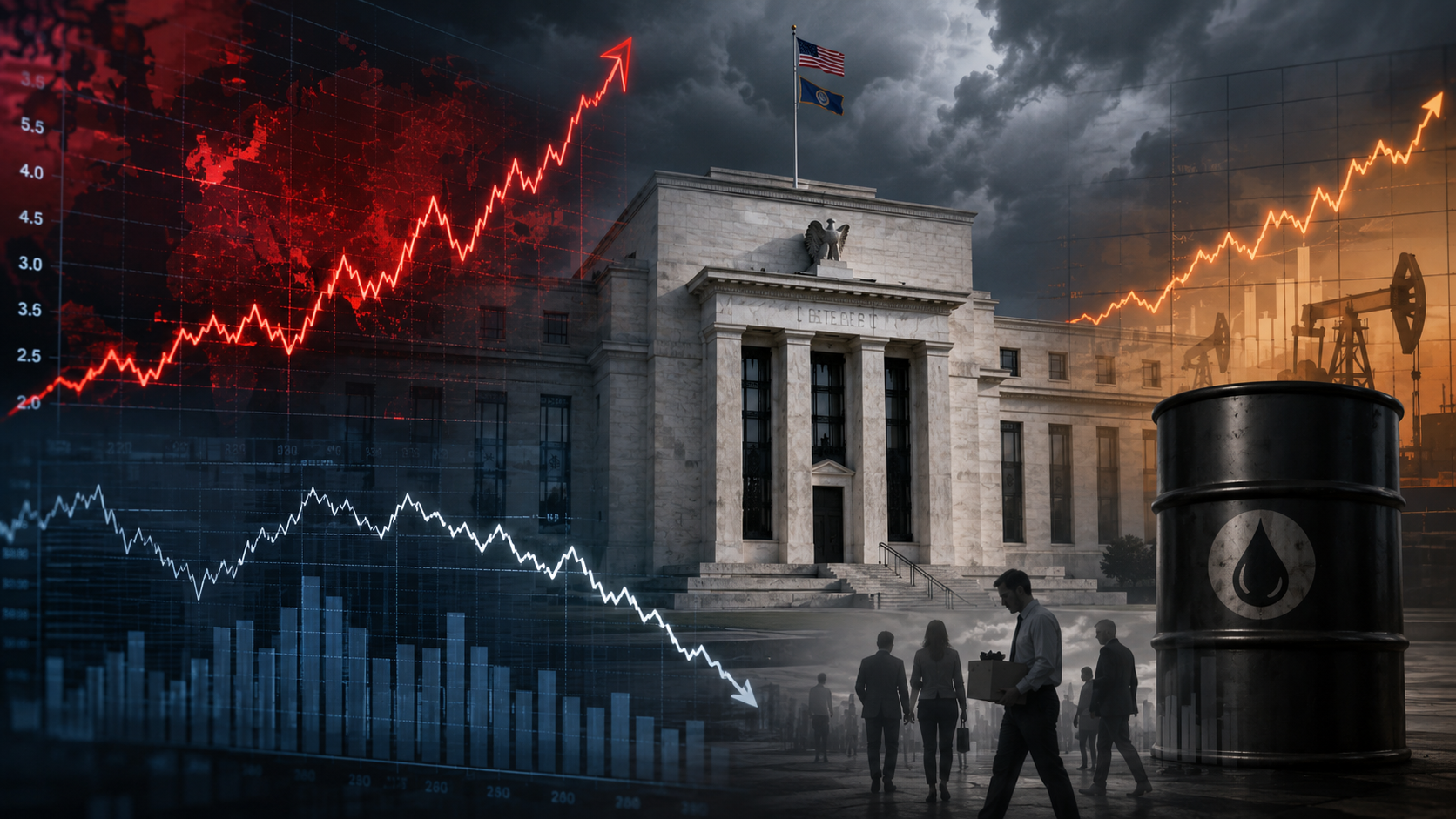

At first glance, the U.S. stock market still looks strong. The major indices remain close to their highs, large technology companies continue to benefit from strong growth related to artificial intelligence, and corporate profitability is still supporting the market. But beneath the surface, a much more challenging picture is developing: long-term U.S. Treasury yields have moved above 5%, oil is once again trading above $100 per barrel, and the Federal Reserve is gradually becoming more hawkish.
These three factors are now coming together into one broader story — a renewed rise in the cost of money.
The yield on the 10-year U.S. Treasury has already climbed above 5.2%, reaching levels not seen in nearly two decades. This is not just a number that matters to the bond market. Government bond yields are one of the main anchors used to price virtually every other financial asset. When investors can earn more than 5% on U.S. government bonds, which are considered relatively low-risk assets, they begin to question why they should continue paying such high valuation multiples for stocks.
The impact is especially important for growth and technology stocks. A large portion of their valuation is based on profits expected to arrive years into the future. As the discount rate rises, the present value of those future earnings declines. That means a market can continue to enjoy strong corporate earnings growth while still experiencing a contraction in valuation multiples.
But this time, the problem is not coming only from the bond market.
Oil prices have returned to very high levels, with Brent trading above $105–$107 per barrel amid Middle East tensions and concerns about potential supply disruptions. High oil prices are not only an issue for the energy sector or for consumers at the gas pump. Energy costs flow through nearly every part of the production chain: transportation, logistics, manufacturing, agriculture and raw materials. If energy prices remain elevated for an extended period, they could interrupt the disinflation process and potentially create a renewed wave of inflationary pressure.
And this is exactly where the Federal Reserve enters the picture.
If inflation were continuing to decline clearly and consistently, the Fed could afford to look through some of the rise in bond yields and simply wait. But when oil prices are rising at the same time, economic activity remains strong and the labor market is not breaking down, the central bank has less room to ease policy. Markets have already begun pricing a significant probability of another rate increase at the end of October.
This effectively creates a trap for the equity market.
On the one hand, the economy is strong enough to support corporate earnings. On the other hand, that same economic strength keeps inflation and interest rates elevated. In other words, good news for the economy can become less favorable news for financial markets because it delays the possibility of lower interest rates.
That also explains why the bond market has now become perhaps even more important to watch than the S&P 500 itself.
When the 10-year Treasury yield trades around 5.2%–5.3%, every additional increase begins to affect the real economy. It raises mortgage rates, consumer borrowing costs, corporate financing expenses and the cost of issuing debt. Even the largest companies are not immune. The enormous investments being made in AI infrastructure, data centers and semiconductors require massive amounts of capital, and a growing share of that capital is being financed through debt markets. A higher cost of capital could eventually begin to weigh on the pace of investment as well.
What is particularly interesting is that stocks are still holding up despite all of these pressures.
That may be one of the most important stories in the market right now. A few years ago, a 5% yield on the 10-year Treasury would probably have triggered a much sharper equity correction. Today, however, the major indices remain relatively close to their highs. The reason is that several opposing forces continue to support the market: earnings growth, AI-related investment, large-scale share buybacks and strong liquidity among many of the largest companies.
But that balance is becoming increasingly fragile.
If bond yields stabilize or move lower, the market may be able to continue coping with the current interest-rate environment. But if the 10-year yield continues moving toward 5.5% or higher, while oil remains above $100 and the Fed signals further tightening, pressure on equity valuations is likely to increase significantly.
That is why, over the coming period, it may be less important to ask whether the S&P 500 is near a record high and more important to ask what is happening in the bond market.
Bonds are currently the key barometer for global markets. They tell us what investors think about inflation, growth, Federal Reserve policy, government deficits and the cost of capital. And if yields continue to rise, at some point the equity market may find it increasingly difficult to ignore that message.
The bottom line: the market is still holding up, but it is doing so against increasingly powerful headwinds. Treasury yields above 5%, oil above $100 and a more hawkish Fed are not necessarily an immediate trigger for a sharp selloff — but together they are creating an environment in which investors have less and less room for error.
Want to keep the discussion going on WhatsApp?
Join the TradeTechAI WhatsApp group to talk about this article with other traders.
Written by
Admin User
Editor
Editor at TradeTechAI, covering market analysis, trading strategies, and portfolio insights.